Showing posts with label Australia. Show all posts

Thursday, 6 January 2022

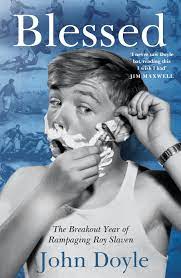
Blessed - The Breakout Year of Rampaging Roy Slaven by John Doyle.


A wonderful piece of writing, this is a novel and memoir, narrated by a fictional creation of the author, who is the long-standing comedic alter ego of the author.

Most Australians will be familiar with the comedy genius of John Doyle as 'Rampaging' Roy Slaven and Grieg Pickhaver as HG Nelson. 

Doyle as Slaven takes us to Lithgow, their home town west of Sydney, in 1967. Roy and Doyle are classmates at the town's Catholic boys school, de la Salle College. (Lithgow is the finest locale in the world - you wouldn't want to be anywhere else - all other places within the boys' ken are "shit"). 

It is both a coming-of-age novel and a memoir - a year in which Roy's astounding (fictional) sporting career is emerging, and Doyle's writing, comedic and sports commentating skills, as well as his atheism, are taking shape.

It is by turns very very funny (I made my partner suffer through readings aloud several times), and very poignant. I developed a tear in my eyes a couple of times. More than anything else, it prefectly evokes an era when Catholics versus Publics was a standard part of small town (and suburban) life , when a woman was blamed for her husband absconding & divorce was a sin, when kids tore around with almost unfettered freedom, and priests and brothers were capricious, sometimes cruel, and sometimes great teachers (often by accident) by turn. It also has great affection for small town community life. It does not discount the darker sides of life such as domestic violence, deserted wives and outrageous pressure brought to bear by the church. 

There's also coal dust, and the local picture theatre and swimming pool. 

Doyle has inhabited Roy Slaven for so long that as he says in a short sentence towards the end, they need each other. Roy, who, of course, has been a champion at every sport to which he has turned, is nonetheless a modest chap, even rather surprised at his own prowess. More than anything else, he loves his Mum, who is starting to emerge as an independent woman, mainly due to an economic and social situation which makes her possible to improve circumstances for herself and her son through work opportunities. His observations of life in the Doyle household show us glimpses of John's autobiography, in particular his relationship with his sister who had autism - in the days before there was a ready diagnosis, or educational assistance (this aspect of Doyle's story he has told elsewhere - see the link in Comments). 


Doyle, via Roy, tells us two things about himself - he is compassionate and kind, and he is well aware that it is often hard to tell when he is being serious or satirical. 

Can't recommend it highly enough. 

***

The evocation of the scene at the local public pool : 

" The summer Dad left was dry and hot. Not much to do until the cricket restarted. I spent a lot of time at the pool. It was fairly new. There was a toddlers' pool with a fountain and an Olympic pool. It was set on a slope. Wide concrete paths bordered a luch lawn bordered by a few trees and a ten-feet high wire mesh fence. The cncrete was tesselated - light and dark. We'd lay on the light when it was hot and the dark when it was cool." (p 37)

"Dean and Doyle were interested in lifesaving. Weird. They would time themselves doing laps of freestyle, breaststroke, sidestroke and water sculling. They were planning to do the Bronze Medallion. Most of the time we filled our days by diving in and bobbing about, doing exotic dives and bombing people. Any girl was fair gameAnd we'd swim underwater. Dean and Doyle could do a lap and a half underwater in one breath....

"We'd lie on the concrete in our togs and chat. We all wore Speedos. The pool manager, Mr Mulcahey, put speakers in the pool shop by the entrance and the radio would be broadcast aross the whole area. " (p 38)

"Dean and Doyle were congratulated at assembly for being the first boys at the school to be qualified lifesavers. They'd successfully completed the Bronze medallion, which meant they had swum the distances in the required time and learnt the techniques of rescue and recovery. They bored us all with talk of the Silvester-Brosch method of resuscitation. And they wore a small black-and-white official lifesaving patch on their swimmers. They must have thught it looked 'cool'. It didn't. It made them look like crawlers and dicks.They were already planning to upgrade to the Bronze Cross, which would mean another patch on the Speedos. 
    I never saw them actually rescue anyone." (p 47)

"Back at the pool. The grassy area on the slope by the deep end was considered the Catholic area. The flat grass on the other side of the deep end was the Publics'. " (p 65)

"Our girls wore modest one-piece swimming costumes, Not so the Publics. We'd often stare across the pool at the bikini-clad girls with names like Vicki and Sharon and Julie." (p 66)

"Flynn had a real girlfriend. He said many of the Public girls were just like Vicki Westwood and he began to sit opposite us at the pool, with the Publics, and Dean thought he was probably in a state of mortal sin. Doyle thought it was possible. I wasn't sure. I couldn't see a real problem with it. 

" At one point Flynn and Vicki Westwood kissed. 

'Brazen' said Carmel.

Brewer and Brennan applauded. " (p 68)

"Ten minutes later, Doyle stands and asks if anyone is interested in wandering over to have a chat to Flynn. I stand. There are no other takers. 

Carmel is incensed. 'You are going to look ridiculous.'

Deirdre and Barbara wish us luck. 

We both leave our towels on the slope and head off around the deep end of the pool and enter Public territory. We are not heckled. We are ignored. Self-consciously, we stand over Flynn and Vicki Westwood. Vicki Westwood is talking to a friend called Janet. Flynn is sunbaking with his eyes closed. Vicki Westwood introduces us to Janet. They are friends of Jeff's. Roy and John. This is Janet.'

Flynn opens his eyes. 'What's going on?' he says. 

Doyle says, 'We felt like a walk.'

Janet asks Doyle about the patch on his costume. 

'It's a lifesaver's patch.'

'Are you a lifesaver?'

Doyle nods, sheepishly. 

'So, if I'm drowning, what are you going to do?'

'Umm...Swim to you, grab your arm and twist you around and take hold of you and sidestroke yu to the wall.' 

I say, 'That's just for starters. Don't get him onto Silvester-Brosch.' " (p 68-70)

....

"We stayed with Flynn and the Publics for about ten minutes before ambling back to our towels and our group. Janet was very chatty and funny. Just like Vicki Westwood. 

Doyle says, 'What an interesting experience. Janet and Vicki Westwood enjoy smut as much as we do. But to them it's not sinful. Not sinful at all.'

I nodded. He was right. 

Our group look at us closely  when we resettle. 

Carmel says, 'Well? What did you talk about?'

Doyle says, 'Sin, Carmel. We talked about sin.'

'Well you were in the right place.' " (p 70)


Tuesday, 19 January 2016

WimSwim: Women Only Swimming

Thebarton Aquatic Centre (Adelaide) all-female swimming program co-ordinator Arnesa Kaumivic with her daughter Aida, 4.   
 Recently when I was at the pool doing my laps, I noticed a leaflet advertising Wimswim 2016 a program through January and February consisting of:


  • Learn to swim lessons for women (aged 15 years and over) - $84.70 for a 7 week program (includes pool entry, which is $6, so lessons are only $6.10 each)
  • Lessons for girls (5 to 14 years) - $72 for a 7 week program (includes pool entry)
  • Leisure swimming for girls and women who can already swim and want to improve and enjoy swimming in a female-only environment - $46.20 for a 7 week progam (includes pool entry)
This is a terrific initiative of the NSW Office of Sport and Recreation, and aimed in part at attracting the mums who often take their children to the pool, but who missed out learning to swim themselves. Many come from other countries where swimming for women isn't always a norm. 

Further information can be found at this link: Wimswim 2016


Thursday, 22 January 2009

Swimming Australia One Hundred Years by Murray Phillips

I came across this book at Bay Books in Batemans Bay while we were on holidays. It's the story of how organised swimming, leading up to the current highly developed competitive swimming scene. The chapters I liked the most were the ones on bathing in colonial times and the one about different places Australians have swum including early sea bathing, floating pools, baths that have long since disappeared, and others which are still going strong after 100 years, and Australia's early Olympic history. There are chapters on coaches and coaching, and the golden eras of Olympic swimming. The book was published in conjunction with the 100 year anniversary of the governing body of swimming, Swimming Australia. 

 The illustrations in this book are fabulous, from the sepia-toned historical ones to amazing underwater shots made possible through modern technology. There's lots to admire in terms of the human body - and looking at the differences in physique development over the years, a product of diet, coaching science and training. 

 For a swimming nut, stumbling on this book was joyful. The only thing I'd like now is a longer volume about leisure swimming in Australia. Maybe I need to write it myself? 

 Publication: Published by University of New South Wales Press, 2008 ISBN 978 1 921410 81 9

Tuesday, 23 December 2008

Swimmers: Andrew Boy Charlton

Last night on TV I saw a terrific program in the series Face Painting With Bill Leak. Leak is best known as a cartoonist, but is also a portrait painter, and in this series he paints six people who are dead. He talks with friends and family of his subjects, and visits locations relevant to their story. Last night's episode was on legendary Australian swimmer, Andrew "Boy" Charlton. You can download the entire episode from here. The finished portrait is simply marvellous. 

 One thing I picked up in the show was that Boy Charlton used to spend his time fishing at Rosedale, on the NSW South Coast...one of my favourite haunts: see my Rosedale and Beyond blog. Charlton came from Manly in Sydney. His nickname "Boy" came from the fact that he was only 14 years old when he first came to prominence by beating visiting champion from Hawaii, Bill Harris (the 100m bronze medallist from the 1920 Paris Olumpics) - and it stayed with him. He was 15 when he took 19 seconds from the world record to win the NSW 880 yards freestyle title in January 1923, and 16 when he beat the mighty Frank Beaurepaire in a 440 match race. Beaurepaire, one of the nation’s heroes - a man who had swum in his first Olympics when Charlton was less than a year old - was then twice his age. (Source: Australian Olympic Committee site) 

 There's a swimming pool in Sydney named after him - called the ABC Pool for short. It was previously known as the Domain Baths and celebrated its 100th birthday this year (not in its current form!). I've shown it on this blog before. Less well known is the Manly Andrew Boy Charlton Swim Centre. 

Here's what the entry in the Australian Dictionary of Biography Online has to say about Charlton:

 "CHARLTON, ANDREW MURRAY (1907-1975), swimmer, was born on 12 August 1907 at North Sydney, only son of Oswald Murray Charlton, bank manager, and his wife Ada Maud, née Moore. 

Known as 'Boy', he was brought up at Manly where he revelled in the surf. Educated at Manly Public School, and at Sydney Grammar School in 1921-22, he entered Hawkesbury Agricultural College in January 1923. 

 On 13 January at the State championships Charlton swam 880 yards freestyle in 11 minutes 5.2 seconds, taking 19 seconds off the world record. In January next year at the State titles held at the Domain baths in Sydney he defeated the great Swedish swimmer Arne Borg over 440 yards freestyle, equalling Borg's world record of 5 minutes 11.8 seconds—the cheering was heard in Martin Place. Next Saturday before a wildly enthusiastic crowd he beat Borg in the 880 yards freestyle event by 15 yards, setting a world mark of 10 minutes 51.8 seconds. 

These feats helped to revive public interest in competitive swimming and, dubbed the 'Manly Flying Fish', he became a popular sporting idol. His trainer was Tom Adrian. 

 At the 1924 Olympic Games in Paris Charlton won the 1500 metres title in 20 minutes 6.6 seconds, setting new Olympic and world records; he was only the third Australian to be awarded a gold medal in swimming. In the same race, 13 minutes 19.6 seconds was a world mark for 1000 metres. He was third in the 400 behind Johnny Weissmuller and Borg, and one of the 4 x 200 relay team which came second. Despite illness, he won other races in Europe, including every event he entered in the Tailteann Games in Ireland, before returning to a tumultuous welcome in Sydney. 

In December he left Hawkesbury Agricultural College without graduating in the diploma course, and worked on Malcolm McKellar's station, Kurrumbede, at Gunnedah. On 8 January 1927 Charlton, now trained by Harry Hay, set a new world record of 10 minutes 32 seconds for 880 yards. He returned to Gunnedah and next year was seriously ill with rheumatic fever. 

In 1932 he set new Australian records for 440 and 880 yards, but was unplaced in the 400 and 1500 metre events at the Los Angeles Olympic Games. In 1934 Charlton moved to Canberra and entered a pharmacy business with a friend and former Manly swimmer John L. Davies; he became captain of Manuka Swimming Club. Representing Canberra at the New South Wales championships in Sydney in January 1935, he beat the French and Australian champions Jean Taris and Noel Ryan in the 880 yards in one of his greatest swims and last race. Next year he took up sheep-raising with J. Hyles on part of Woolowolar, near Tarago. 

On 20 March 1937 at St Mark's Church, Darling Point, Sydney, he married Jessie Muriel Hyles. He then settled on a 12,000-acre (4856 ha) property, Kilrea, at Boro near Goulburn, and became a successful grazier. Extremely shy and modest, 'Boy' shunned publicity. He refused offers to turn professional saying: 'I would never be forgiven by the Australian public … I am not in the sport for what I can get out of it'. He never won an Australian title, but to Australians in the 1920s he was a popular idol and national hero. 

 Survived by his wife, son and daughter, Charlton died suddenly of a heart attack at his Avalon home on 10 December 1975, and was cremated. His estate was valued for probate at $131,850. 

 Charlton's stroke was a four-beat, trudgen crawl, called by some at the time the single trudgen crawl. There was very little leg movement: the wide scissor kick was made horizontally at the end of the left arm drive with the body turned well sideways, then followed two or three vertical kicks. His powerful arms and withering final sprint made him a champion, despite the fact that he rarely trained, preferring to surf instead. 

In 1968 the new Sydney Domain baths were named after him and in 1972 he was honoured by the International Swimming Hall of Fame at Fort Lauderdale, Florida, United States of America." 

Below: Medal ceremony 400m freestyle, Paris Olympics 1924. Boy Charlton (Bronze), Johnny Weissmuller (Gold) and Arne Borg (Silver).

Saturday, 6 December 2008

Sunday, 27 July 2008

Australian mythologies - Gallipoli and Swimming

The 1915 landing at Gallipoli has assumed a mythological place in the Australian story. Despite defeat it is a national "coming of age" story, when for the first time Australians and New Zealanders saw themselves as other than "mother country colonials".

In the same way swimming has a place in the concept of Australians as outdoorsy, physical types (despite much obesity-related evidence to the contrary!). The Australian Crawl is the name given to the swimming stroke most commonly used today (the 'front crawl')

Sometime between 1870 and 1890, John Arthur Trudgen learned the front crawl from Native Americans during a trip to South America. (The exact date is disputed, but is most often given as 1873.) However, Trudgen mistakenly used (in Britain) the more common sidestroke (scissor) kick instead of the flutter kick used by the Native Americans. This hybrid stroke was called the Trudgen. Because of its speed the stroke quickly became popular.

The Trudgen was improved by the Australian-born son of swimming teacher, "Professor" Richard (Fred, Frederick) Cavill, champion swimmer Richmond (Dick) Cavill (1884–1938). While he and his brother "Tums" developed the stroke independently, they were later inspired by Alick Wickham, a young Solomon Islander resident in Sydney who swam a version of the crawl stroke that was popular in his home in the Roviana Lagoon. This modified Trudgen stroke became known as the Australian crawl.

So, combine the Gallipoli legend, and the Australian predeliction for swimming, and what happens?

“Swimming in the sea was popular with the men at Anzac particularly as their daily water allowance left little for washing either themselves of their clothes. As the weather turned hot, the beach sometimes looked like a holiday resort. The Turks began lobbing shells into the sea amongst the bathers, but the men continued to swim there. " - from Patrick Carlyon, The Gallipoli Story. Penguin 2003

Jack Buntine, a Gallipoli survivor said in an interview:

"Taking risks in life is recommended; after all, you might be killed crossing the road - but the risks that Buntine took demonstrated a devil-may-care attitude. “Oh, we used to go swimming’ at Gallipoli and they would be shootin’ at us. You’d see bullets goin’ in the water around you - but they didn’t worry me. Johnny Turk was not going to stop me swimmin’. "
From: This website (click)

Below: Beach scene, Anzac Cove

Below: Soldiers swimming from barges, Anzac Cove. As we see below, those soldiers included the British Commandeer of the Australian And NZ troops, Lieutenant Genral William Birdwood.


Below: Birdwood swimming at Anzac Cove, May 1915. "General Birdwood enjoyed a swim when possible. In the water, naked like everyone else, he was sometimes mistaken for a lowly private. Journalist Phillip Schuler wrote that one day a canvas pipe from a water-barge fell into the sea. The barge-man, not recognising the general, yelled at him: ‘Well lend a fellow a *&^%* hand to get the *&^%$^ thing up.’ Birdwood did not punish the barge-man for his rudeness. Rather, he helped out and later delighted in re-telling the story.” Patrick Carlyon, Penguin 2003.


Below: The beach at Anzac Cove.
Below: Mixed media work by Australian artist Sidney Nolan entitled Anazac Swimming at Gallipoli
This article by Steve Meachem says:
"Jane Clark, the deputy chairwoman of Sotheby's Australia and author of Sidney Nolan: Landscapes and Legends said Nolan was staying with the novelist George Johnson on the Greek island of Hydra in 1956 when he visited the war correspondent Alan Moorehead, who had written his best-selling account of Gallipoli on the nearby island of Spetsae. Nolan was struck by the similarities between the first Anzacs and the Homeric heroes.

In the 1950s Gallipoli was much less established in Australian mythology than now. Most of the focus was on World War II. But in the Gallipoli campaign, Ms Clark said, Nolan saw the same "legend of failure" that attracted him to the stories of Ned Kelly and of Burke and Wills.
Perhaps Nolan was thinking of his own less-than-heroic military failure. In July 1945, fearing front-line duty in New Guinea, he deserted from the army. Still it was these Gallipoli paintings that consolidated his international reputation."

Below: Swimmers at Gallipoli by Sidney Nolan (Australian War Memorial collection)