Showing posts with label Countries Other Than Australia. Show all posts

Monday, 20 December 2021

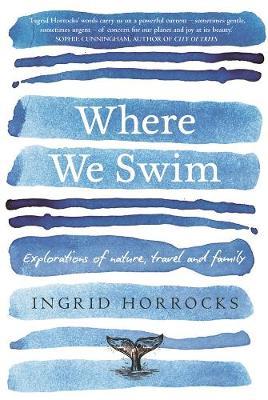
Where We Swim: Explorations of nature, travel and family by Ingrid Horrocks


 At its best when talking about family connections and the spaces between us and bonds of love that hold us together. Not "just" a book about swimming. Opens with the author on a solitary journey, and intending to swim alone in various places and keep a Waterlog (like the late author of that wonderful book of that name, Roger Deacon). But it becomes so much more. I like the eclectic swimming places - and even the longing for a swim that cannot happen (in Medellin, Colombia, where someone pooing in the pool at a rented apartment keeps it closed). The "pool" in the Amazon River retreat is simply astounding. 

Horrocks also takes us deep into the global climate crisis and how we react while being middle class privileged folk. I was living in one of the areas of Australia burning in the summer of 2019, sending clouds of smoke across the Tasman. 

It finishes with the impact of Covid lockdown in New Zealand and how people gently connect with strangers when allowed back in the water. 


Wednesday, 1 December 2021

The Lido by Libby Page (Fiction), and some musings about lidos.

Win a copy of The Lido by Libby Page — it's set to make a splash this summer

Books look ahead 2018: What will you be reading this year? - BBC News

In British parlance, a lido (pronounced, weirdly, Lie-do, not as it is from the Italian word lee-do, meaning ), meaning shore, as in the Lido in Venice) is an unheated outdoor swimming pool. They are treasured parts of the communities in which they are located, and have come under increasing threat of closure over the past few decades as local governments seek to cut costs. [Another casualty of bean-counting removal of community facilities have been public libraries - which is also touched upon in this book. 

Libby Page is a journalist, and keen swimmer. This is her debut novel. It tells the story of two women who form an indelible friendship over the fight to save the un-fictitious Brockwell Lido. One is a lacking-in-confidence young journalist named Kate, whose physical appearance seems to be rather akin to that of Kate in the pic above! She is new to the Brixton area of London. She suffers panic attacks. Kate is living a lonely life in a dire share-house where no-one has any contact with anyone else. Kate meets Rosemary, an older woman in her late eighties, recently widowed, who has lived all her life in Brixton, and has  been swimming at the lido for 80 years. The lido played a large part in the love story between Rosemary and her late husband, George. 

I enjoyed the book, especially since I share many of the author's interests - swimming, saving swimming pools, libraries, cooking. 

I especially liked the depiction of the coming together to a diverse community and the tactics they used to save their pool....see my entries on Bexley Swimming Pool (linked below), which we managed to save. Like in the book, we had some great support from the local newspaper. Not QUITE so fortunate at Batemans Bay, where, despite some vigorous campaigning (see link)  we lost the outdoor 50m pool and are acquiring an indoor 25 metre pool....a regressive step in my opinion. 

Bexley pool battle ; 

The fight to save Bexley pool part 2 ;

2011 update ;

Open House Feb 2014 ;

Making submissions to Council ;

Last laps at the old pool ;

After seven years of fighting, a commencement of construction ceremony

Aerial shots of the development ;

We won! Bexley pool reopened

All my posts on Bexley Pool.

One of my favourite passages from the book describes the importance to community of such assets. 

" 'When the old library closed down no one realised the importance of what we were losing until it had gone. It was a place for learning and also a centre of our community. And it's the same with the lid. We all take it for granted and that is why it is so important. We rely on it being there for us. It is somewhere you can go for a moment to yourself, whatever your reason may be for needing that moment....

'The lido holds so many memories for us all. For children who have never been to the seaside it is their summers and their freedom. For parents it is the memory of seeing their child swim for the first time - that moment when you just have to let go and let them fly. And for me, well it is my life."

I do have to admire the cold-water swimmers of the UK. Such water temperatures as those described here, and in At The Pond which I recently read, would see me balk - possibly even in the "warm" months! I guess we are blessed in Australia. 

Another way we are blessed is that municipal pools here are plentiful. Sydney is blessed not only with dozens of 50 metre outdoor pools, but ocean and harbour pools as well. Our pools also most usually have plentiful grassed areas and facilities like barbecues are common. A friend visiting from the UK whom I took to Bexley Pool (pre-redevelopment) declared it "like a resort". Another woman I met swimming there, who migrated from China, said that her family spends thousands of dollars visiting resorts on their holidays, whereas she spends $5 going to the local pool! 

Libby Page's page. Author / Swimmer/ Optimist

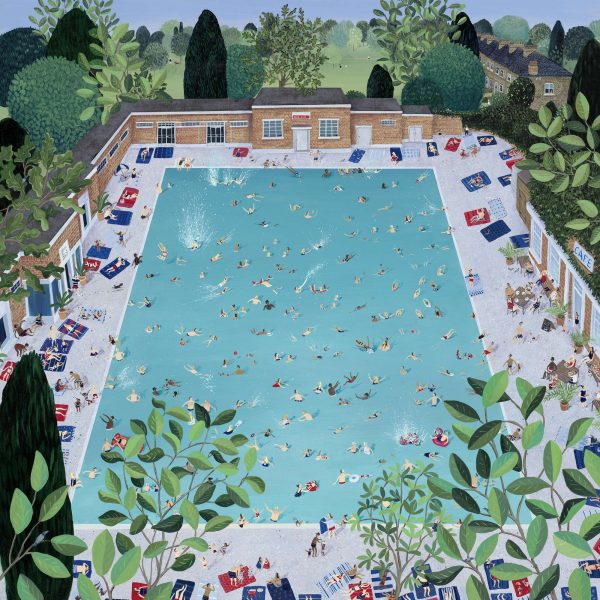
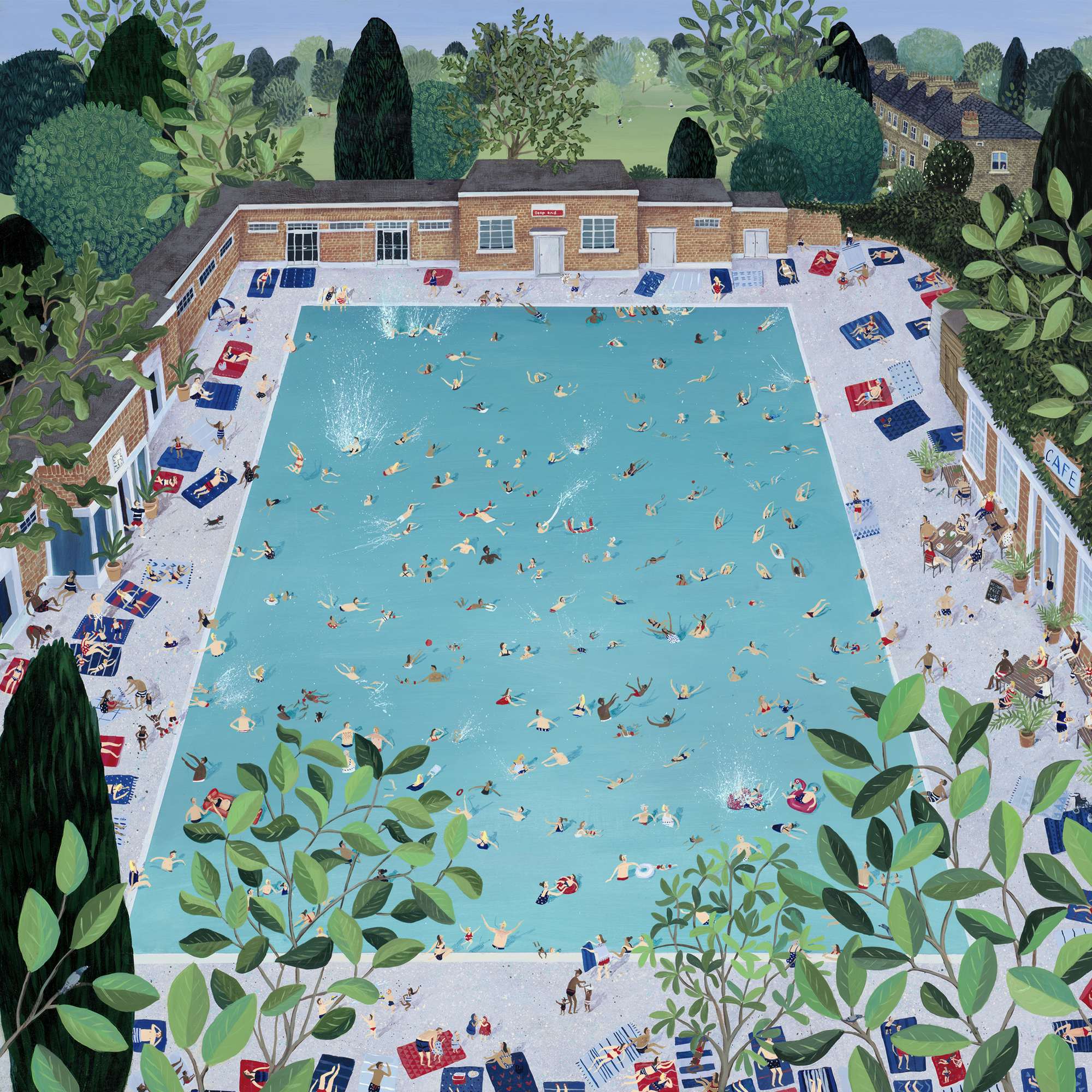
In researching this post, I found this gorgeous art print of Brockwell Lido by Jenni Murphy. You can buy it from this page. 
Read more: 

BLU - Brockwell Lido Users group

A blog about swimming at the Brockwell Lido (Londonist)

Brockwell Swimmers -  a swimming club 


Saturday, 27 November 2021

At the Pond: Swimming at the Hampstead Ladies' Pool (Daunt Books, 2019)

Photo from CultureFly.co.uk 


I found this small volume of 14 essays utterly intriguing. 
Hampstead Heath in London contains three swimming ponds (and others for angling, model-boating etc; created when the Fleet River was damned in the 17th and 18th centuries as reservoirs for water supply to Hampstead and Highgate). The swimming ponds are one for women, one for men and one mixed. 
The writers who contributed include some well-knon, Like Margaret Drabble and Esther Freud, some not so well-known. It is divided into 4 sections, Winter, Spring, Summer, Autumn. Some swim year-round, some are summer-only. 
The Pond as it is known is legendary amongst certain Londoners. It is "wild swimming" in a huge city ... many describe the wildlife and the vegetation...moorhens, ducks, snakes, reeds and grasses etc. The temperature is never what I would call warm, and in winter there can be ice, and of course snow on the ground. There seems to be several hundred hearty souls who do swim year round. However, there also seems to be a sort of reverence, an elitist aura around them. One writer says "they know the lifeguards". 
Also intriguing are some of the "rules" and customs ... eg there can only be a certain ratio of swimmers to lifeguards, so on a hot summer's day you may have to wait to drop in down the metal railing. Imagine trying to impose that at one of Sydney's (un-lifeguarded) ocean pools!) 
Hampstead and Highgate are high-end London suburbs, nowadays often populated by the very wealthy, though they weren't always - they were arty and bohemian in the past. 
I couldn't help comparing the Pond's mores with those at Sydney's McIvers Baths - the Ladies' Pool at Coogee. Some seem similar - the older coterie of "gatekeepers", sticking within your own groups, the basic changerooms, topless sunbaking, but the convivility in the water, and the style of swimming seems a little more open at McIvers. As well, apart from a couple of essayists with southeast Asian heritage, there is know mention of it as a refuge for diverse cultural groups like Muslim women or nuns or others who want to swim in a women-only environment. 
There was a major controversy a couple of years ago, when the London Corporation, which manages the Pond said it was ok for transitioning or transitioned male to female Transgender users to officially use the pool (they had been anyway), with backlash from some. That seems to have settled down now. 
It probably helps to be a swimmer to enjoy the book, but I think it's also interesting in broader cultural terms as a slice of London life.

Here's the page of the Kenwood Ladies Pond Association, a voluntary group of women which cares about the Pond. There's new and info about current campaigns. There is a video called "City Swimmers" in the Gallery.

A story about closure due to sewerage leaks, and a protest against compulsory charges.

Here's some reviews of the book: 

By Natalie Xenos - click here.

By Rebecca Armstrong - click here.

You can easily search for more online. 


Tuesday, 25 September 2012

Paris: Piscine Deligny and Piscine Joséphine-Baker


Swimming in Paris: a long-held ambition, and in July 2011 I decided to take some time out from the sales and gardens and take a dip. I'd previously been a bit daunted by the apparent rules and regulations at French swimming pools, but having put my metaphorical toe in the water in Monaco a few years earlier, I figured I was up to the challenge! With my best terrible French practiced in the metro on the way, I felt ready to venture forth.

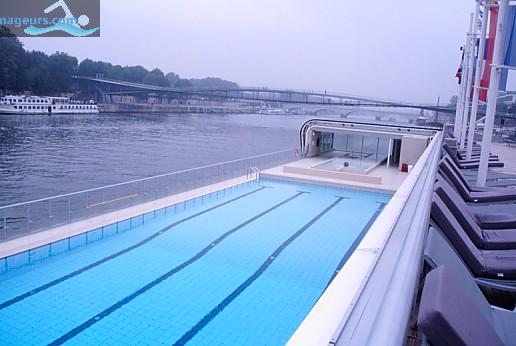
I was on a bit of a "women in Paris" bent at the time, and was delighted to discover that the Piscine Josephine Baker is on the left bank of the Seine - actually floating in the Seine - near one end of the Passerelle Simone de Beauvoir in the 13th arrondissement

The Seine used to accommodate many floating swimming pools, the last of which , the Deligny sank in a storm in July 1993.


The Deligny was first built in 1801, and the last version in the early 20th Century.


Josephine Baker was an American born actress, civil rights activist, French Resistance heroine, and first American born woman to receive France's highest military honour, the Croix de Guerre.

In 2006, this pool opened. It floats on a barge off the Quai François Mauriac at Port de la Gare. It was built in Rouen and floated up the river.

Photography is banned in the pool....a mother was even prevented from taking some photos of her own children while I was there, so I snuck ONE photo with my iPhone, which I had hidden under my towel.


I got a few shots of the exterior, including from the Passerelle Simon de Beauvoir.


The water is drawn from the Seine, treated, then retreated before being recycled back into the river.

I was quite pleasantly surprised at the generaous opening hours and entry price : approx 5 Euros for 2 hours, and 2.60 Euros per hour thereafter.
French swimming pool etiquette was a bit daunting at first, but there was an English speaking person at the entrance who demystified MOST of it for me - compulsory shower before entering, compulsory swimming cap (fortunately I had brought one from home, having read this to be the case). You get a locker key, and are not allowed to take extraneous bits and pieces onto the pool deck - it's all rather "serieux", even for a pool too small to really do much serieux swimming!

I did manage to transgress in one important aspect - I wore a pair of thongs (flip-flops) in the changing area - and a cleaner man had to rush up to tick me off (yes, man - the changing areas are mixed, with individual changing cabins. There are some individual showers, some mixed.)

Anyway, the cleaner constantly sluiced the floors in the change area, and it appeared that my thongs could have transmitted some Parisian grime to the floor!

Being female, I wasn't caught by the "no boardshorts / Speedos only" rule. An American family with three young children was turned away on this basis!

The pic below I took from the Passerrelle Simone de Beauvoir - a sinuously curving footbridge linking the Bibliotheque Natinale (Mitterand library) and the Bercy district.


Here's  some pics I found on the web, including an artist;s impression of the retractable roof.


Saturday, 28 May 2011

Cassis (June 2008)

Cassis is a gorgeous, relatively sleepy (though frenetic in high summer I believe) fishing town east of Marseille. We went there for a boat trip around Les Calanques, deeply incised cliffs. I loved the whole atmosphere of Cassis and would very much like to return for an extended period. Perhaps in retirement? With longer to linger, there are many walks in the area that would be worth doing. It seemed a perfect place to be on a deliciously warm late spring day, and the water wasn't TOO cold for a swim!

Above: Cap Canaille, the highest maritime cliffs on the Mediterranean.

Above: Swimming in the enclosure at Cassis Beach - that's Ben and Nathalie standing, and I'm "surfing" in to shore

Above: Post swim nap on the beach

Above: Racing off onto a pedalo

Above: The beach and facilities. The beach was REALLY hard to walk on because it is all fine pebbles that you sink into at every step

Above and Below: One the chief attractions of Cassis is the voat trips around "Les Calanques". This is Calanque En-Vau, perhaps the most beautiful of all. Other than getting a private boat there, and swimming off the boat, you can walk; it's about an hour from Cassis.


Thursday, 31 March 2011

Swimming in Turkey July - August 1989

Unlike Byron, I have never swum the Hellespont (and am not likely to!) - nor for that matter from the Lido in Venice and all the way up the Grand Canal.  The Hellespont is the narrow channel known now as the Dardanelles, the narrow channel connecting the Aegean Sea to the Sea of Marmara.

On swimming the Hellespont, on May 3, 1810, Byron wrote:

                                           'I plume myself on this achievement more than I could possibly do any kind of glory, political, poetical or rhetorical.'

I have however, swum in a number of places in Turkey, and here they are.

The BLACK SEA at TERME
20 July 1989

Looks a bit dull, but the water was fantastic and we enjoyed the swim. Really nice body surfing waves.


AKDAMAR ISLAND in LAKE VAN, Eastern Turkey
28 July 1989

"The origin and meaning of the island's name is unknown, but is often attributed to an old Armenian legend. According to the tale, an Armenian princess named Tamar lived on the island and was in love with a commoner. This boy would swim from the mainland to the island each night, guided by a light she lit for him. Her father learned of the boy's visits. One night, as she waited for her lover to arrive, he smashed her light, leaving the boy in the middle of the lake without a guide to indicate which direction to swim. They say his dying cries of "Akh, Tamar" (Oh, Tamar) can be heard to this day at night." (Wikipedia)

So the origin of its name may lie in swimming.


On the road from KÂHTA to MT NEMRUT
30 July 1989

A very welcome stop at a restaurant  / camping site on a  long and dusty trip to Mount Nemrut. Not sure of its name but it could be Damlacık


KAYA CAMPING,  GÖREME, CAPPADODOCIA
2 August 1989

A lazy day, poolside. Aaaaaaaaaaaah.


SIDE
4 August 1989


After weeks inland, our first sight of the Mediterranean was at Side, where we rushed into the beautiful water and enjoyed a swim in the sea.


BELDIBI  on the MEDITERRANEAN with the TAURUS MOUNTAINS in the background.
4 August 1989

A pebbly shore, backed by sand, right at our campsite. Beautiful swimming in calm, crystal clear, warm Mediterranean waters.


Beach between Beldibi and Demre (Myra)
5 August 1989

I don't know the name of this beach, but it was beautiful.  Entrance was 500 Turkish Lire, but that bought a deck chair. That gorgeous, crystal clear water again.


KAPUTAŞ between Kaş and Kalkan - BLUE COVE
6 August 1989

The most exquisite beach. The road crosses a mountain gorge. Below the bridge is this beautiful cove, reached by stairs from the road.


PAMUKKALE ('Cotton Castle')
7 August 1989

Not really swimming, though people used to.  Due to drought, there was not much water in this area of hot springs and travertine terraces. The ancient city of Hierapolis was founded in the 2nd century BC as a thermal spa. It is now a UNESCO World Heritage Area, and you can no longer walk over it any more like we did, nor immerse yourself in the waters.

I am glad; when we visited, they were a very big disappointment - littered with cigarette butts and a grey, dirty site. Now, apparently , they have returned to their pristine, gleaming white natural state. The terraces are formed from calcium bicarbonate carried in the spring water.


PAMUKKALE - Swimming in the ancient SACRED POOL
7 August 1989

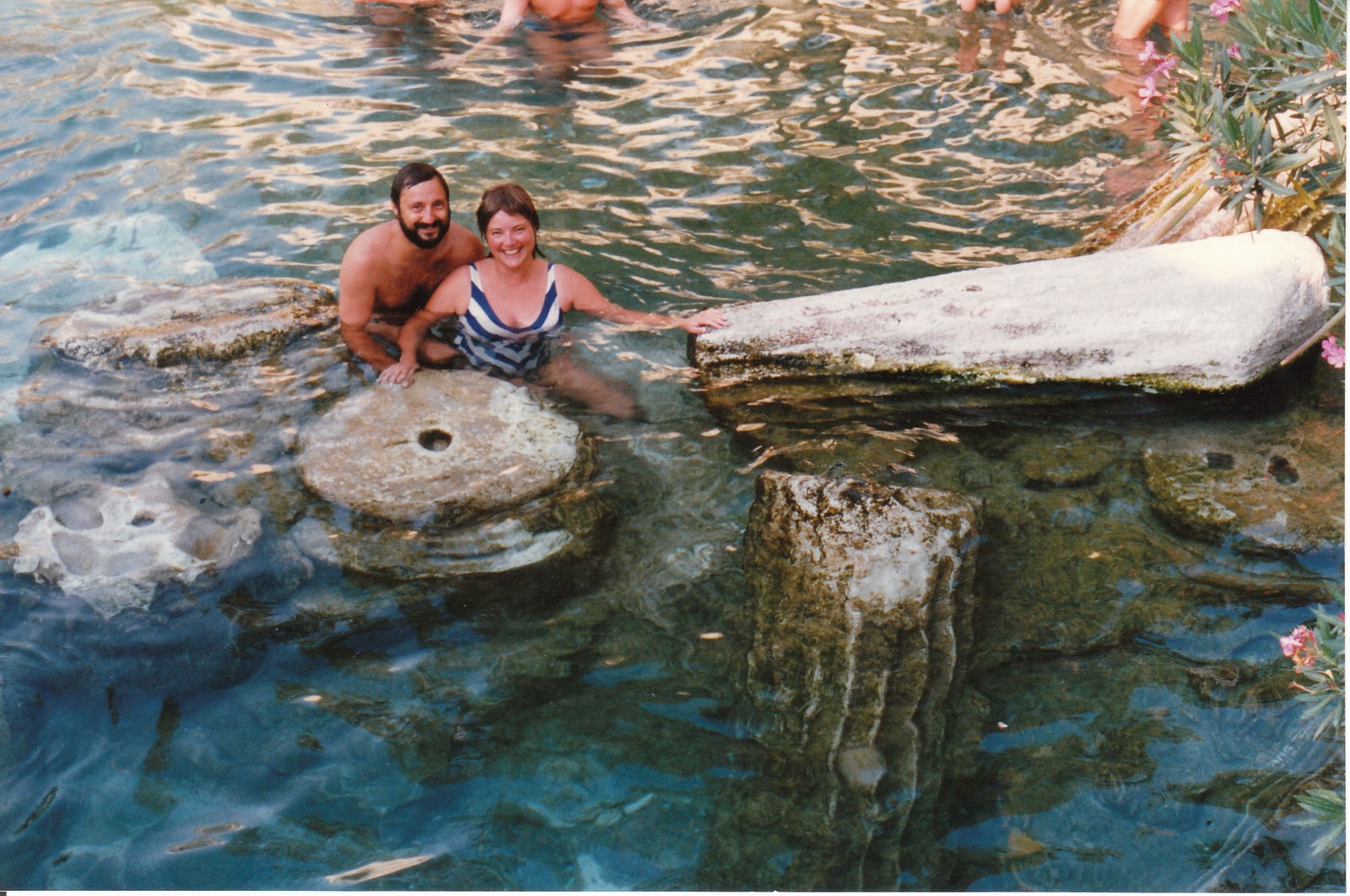
In the grounds of what was the Pamukkale Motel (now a thermal centre) is the ancient Sacred Pool, warmed by hot springs and littered with underwater fragments of ancient marble columns. It is possibly associated with the Temple of Apollo. It was amazing swimmign around over anceinet ruins! During the Roman period, columned porticoes surrounded the pool; earthquakes toppled them into the water where they now lie.

This is where the spring that feeds the mineral pools of Pamukkale originates.


Thursday, 24 March 2011

Swimming from Ancient Rome to Christianity

Sculpture of a mermaid found at a Roman fort near Fors Abbey at Bainbridge in Yorkshire, England.

One of my favourite books about swimming is Haunts of the Black Masseur : the Swimmer as Hero, by Charles Sprawson. I love his chapter on 'Classical Waters' (in Ancient Greece and Rome).

Sprawson tells us that in ancient Rome swimming was associated with sensuality and, eventually, as Emperors built ever more luxurious pools and baths, decadence. The Christian church filled the sea with imaginary monsters.

For Pliny the mermaid was a exciting proof of nature's diversity, her song an irresistible celestial harmony.

For the medieval church her siren song became the lure of fleshly pleasures to be feared and avoided by the godly. Swimming, like sexual pleasure, came to be associated with the devil and was almost suppressed during the domination of Europe by Christianity. Not until the beginning of the 19th century was its popularity revived.

Wednesday, 4 February 2009

Springboard In The Pond

The Springboard in the Pond: an intimate history of the swimming pool, by Thomas A.P. van Leeuwen, edited by Helen Searing (Masachusetts Institute of Technology, 1998). This would have to be one of my favourite books. I found it by chance in a second-hand bookshop in Melbourne. Mainly it is about the domestic swimming pool, and its prime focus is the United States. The book includes much about human attitudes towards water, as well as wonderful drawings, plans and photographs of pools. It is a meditation on the philosophy of swimming as much as anything. My favourite chapter is the first. It incudes discussion of the floating swimming pool as it emerged in Europe in rivers and lakes. Great to read in conjunction with Swimming Australia One Hundred Years, which includes information on these types of pools in Australia. Below: Vienna: Damenschwimmschule, 1831, with diving tower. (Matti-Wurm and Storch, eds. Das Bad, 1991) Below: Jacob Alt, watercolour of the Kaiserliche und Konigliche Militarschwimmschile in Vienna in 1815. (Vienna, Museum der Stadt Wien)

Saturday, 20 December 2008

Midwinter Swim at Brockwell Lido

Above: Postcard of Brockwell Lido the year after it opened (1938)
Above: Midwinter


I subscribe to a Yahoo Group called Lidos, which concentrates on British open air swimming pools (Lidos), and the battle for their preservation.

Recently I received this message:

"Hello, I thought other group members might be interested in knowing about this:

Midwinter Swim at Brockwell Lido – Come on in, the water's lovely!
Woolly hats or swimming caps essential.
Saturday December 20th
Swim from 12.00pm - 1.00pm
Activities/Refreshments from 11.45am - 1.15pm

Last year we had 73 swimmers and a water temperature of 3.2 degrees Celsius. This year we're hoping for over 100 swimmers but with the cold setting in the water temperature could drop even further so be prepared and bring a woolly hat or a swimming cap – or both!

If you don't fancy taking the plunge come and cheer the swimmers on – bring a hot towel to wrap them in and while you're waiting for them you can have a hot drink and a mince pie and learn about the history of winter swimming at Brockwell with BLU (Brockwell Lido Users).

Whether you're a swimmer or a supporter you can have a go at the art activity and customise a woolly hat for the swim or for wearing afterwards to warm up. We'll have some hats but do bring your own and any you have spare will be very much appreciated.

The entry fee is a suggested £1 minimum donation to Age Concern Lambeth; thousands of older people die each minter from cold related illnesses – help Age Concern to Fight the Freeze and keep them safe and warm.Also, at the midwinter swim BLU will be selling books and t-shirts and Elena Tognoli, August's artist in residence, will be there to launch her book "A Step-By-Step Users Manual To Brockwell Lido For People Who Don't Like Water" which she created in collaboration with Lido Users this summer, so as well as an invigorating swim you'll get the chance to do some Christmas shopping!

Hope to see some of you there... "

These people are hardier than I !! I wonder if the Bondi Icebergs and the Brockwell Icicles ever had an exchange program?

Brockwell Lido is in the London suburb of Herne Hill.

Official website of Brockwell Lido

Brockwell Lido Users Group - a group dedicated to maintaining and extending the facilities and services of the Lido.

London Pools Campaign
HAVE A GREAT SWIM!!!