Sunday, 10 April 2011

Famous Swimmers: Benjamin Franklin

Illustration above: found at Picture book directory of children's illustration. This picture is by David Austin Clar. I am sorry I could not contact you to seek permission to use the image, but am happy to do so if you see this and leave me a message.


 Yes, that Ben Franklin, one of the Founding Fathers of the United States, author and printer, political theorist, politician,  postmaster, scientist, inventor, satirist,  civic activist,  diplomat, anti-slaver.  He formed both the first public lending library in America and the first fire department in Pennsylvania.

He was also an enthusiastic, proselytising swimmer and inventor of a prototype hand paddle / swim-fin.

Franklin is recognised in the International Swimming Hall of Fame. The entry on him includes the following information:

" Benjamin Franklin was a competent swim coach and teacher; he advised on water safety, lifeboat rescue escape from shipwrecks, and the advisability of universal learn-to-swim classes.
One of United States first "ornamental swimmers", on a Thames River excursion in 1726, he swam from Chelsea to Blackfriars (3½ miles) 'performing on the way many feats of activity, both upon and under water, that surprised and pleased those to whom they were novelties'.

Ben wrote about his swim fins:

"When I was a boy, I made two oval palettes, each about 10" long and 6" broad, with a hole for the thumb in order to retain it fast in the palm of my hand.  They much resembled a painter's palette.  In swimming, I pushed the edges of these forward and I struck the water with their flat surfaces as I drew them back.  I remember I swam faster by means of these palettes, but they fatigued my wrists.  I also fitted to the soles of my feet a kind of sandals, but I was not satisfied with them because I observed that the stroke is partly given by the inside of the feet and the ankles, and not entirely with the soles of the feet.

Franklin as swimming teacher:

According to the Hall of Fame entry, Franklin wrote:
  
' 'Tis supposed that every parent would be glad to have their children skilled in swimming, if it might be learnt in a place chosen for its safety and under the eye of a careful person . . .'tis some advantage besides, to be free from the slavish terrors many of those feel who cannot swim, when they are obliged to be on the water even in crossing a ferry.'

"Franklin was also a competent coach and teacher.  He taught his friend Wygate and a friend to swim 'at twice going into the river'  but turned down an offer by Sir William Wyndham to open the first American swim school in England.  He was homesick and returned to Philadelphia where among other things, he proposed that all commonwealth schools should have swimming programs.

Max Connors - SeaChange


Like Andrea Camilleri's Sicilian detective, Salvo Montalbano, Max Connors is a swimmer. Like Salvo, he swims through his troubles.

In Series 2, episode 5, after his wife dies, Max can only seek solace in swimming. In fact it also brings him closer to his father, a former champion swimmer.

Max, played by actor William NcInnes, was the (second) heartthrob love interest in Australian TV series, Seachange, which ran for three series, 1998-2000. McInnes appeared in 24 episodes. The show also starred great Aussie acting icons, Sigrid Thornton, John Howard, David Wenham, Kerry Armstrong, Kate Atkinson, Jill Forster, Kevin Harrington, Georgina Naidu and others. 

Thursday, 31 March 2011

Swimming in Turkey July - August 1989

Unlike Byron, I have never swum the Hellespont (and am not likely to!) - nor for that matter from the Lido in Venice and all the way up the Grand Canal.  The Hellespont is the narrow channel known now as the Dardanelles, the narrow channel connecting the Aegean Sea to the Sea of Marmara.

On swimming the Hellespont, on May 3, 1810, Byron wrote:

                                           'I plume myself on this achievement more than I could possibly do any kind of glory, political, poetical or rhetorical.'

I have however, swum in a number of places in Turkey, and here they are.

The BLACK SEA at TERME
20 July 1989

Looks a bit dull, but the water was fantastic and we enjoyed the swim. Really nice body surfing waves.


AKDAMAR ISLAND in LAKE VAN, Eastern Turkey
28 July 1989

"The origin and meaning of the island's name is unknown, but is often attributed to an old Armenian legend. According to the tale, an Armenian princess named Tamar lived on the island and was in love with a commoner. This boy would swim from the mainland to the island each night, guided by a light she lit for him. Her father learned of the boy's visits. One night, as she waited for her lover to arrive, he smashed her light, leaving the boy in the middle of the lake without a guide to indicate which direction to swim. They say his dying cries of "Akh, Tamar" (Oh, Tamar) can be heard to this day at night." (Wikipedia)

So the origin of its name may lie in swimming.


On the road from KÂHTA to MT NEMRUT
30 July 1989

A very welcome stop at a restaurant  / camping site on a  long and dusty trip to Mount Nemrut. Not sure of its name but it could be Damlacık


KAYA CAMPING,  GÖREME, CAPPADODOCIA
2 August 1989

A lazy day, poolside. Aaaaaaaaaaaah.


SIDE
4 August 1989


After weeks inland, our first sight of the Mediterranean was at Side, where we rushed into the beautiful water and enjoyed a swim in the sea.


BELDIBI  on the MEDITERRANEAN with the TAURUS MOUNTAINS in the background.
4 August 1989

A pebbly shore, backed by sand, right at our campsite. Beautiful swimming in calm, crystal clear, warm Mediterranean waters.


Beach between Beldibi and Demre (Myra)
5 August 1989

I don't know the name of this beach, but it was beautiful.  Entrance was 500 Turkish Lire, but that bought a deck chair. That gorgeous, crystal clear water again.


KAPUTAŞ between Kaş and Kalkan - BLUE COVE
6 August 1989

The most exquisite beach. The road crosses a mountain gorge. Below the bridge is this beautiful cove, reached by stairs from the road.


PAMUKKALE ('Cotton Castle')
7 August 1989

Not really swimming, though people used to.  Due to drought, there was not much water in this area of hot springs and travertine terraces. The ancient city of Hierapolis was founded in the 2nd century BC as a thermal spa. It is now a UNESCO World Heritage Area, and you can no longer walk over it any more like we did, nor immerse yourself in the waters.

I am glad; when we visited, they were a very big disappointment - littered with cigarette butts and a grey, dirty site. Now, apparently , they have returned to their pristine, gleaming white natural state. The terraces are formed from calcium bicarbonate carried in the spring water.


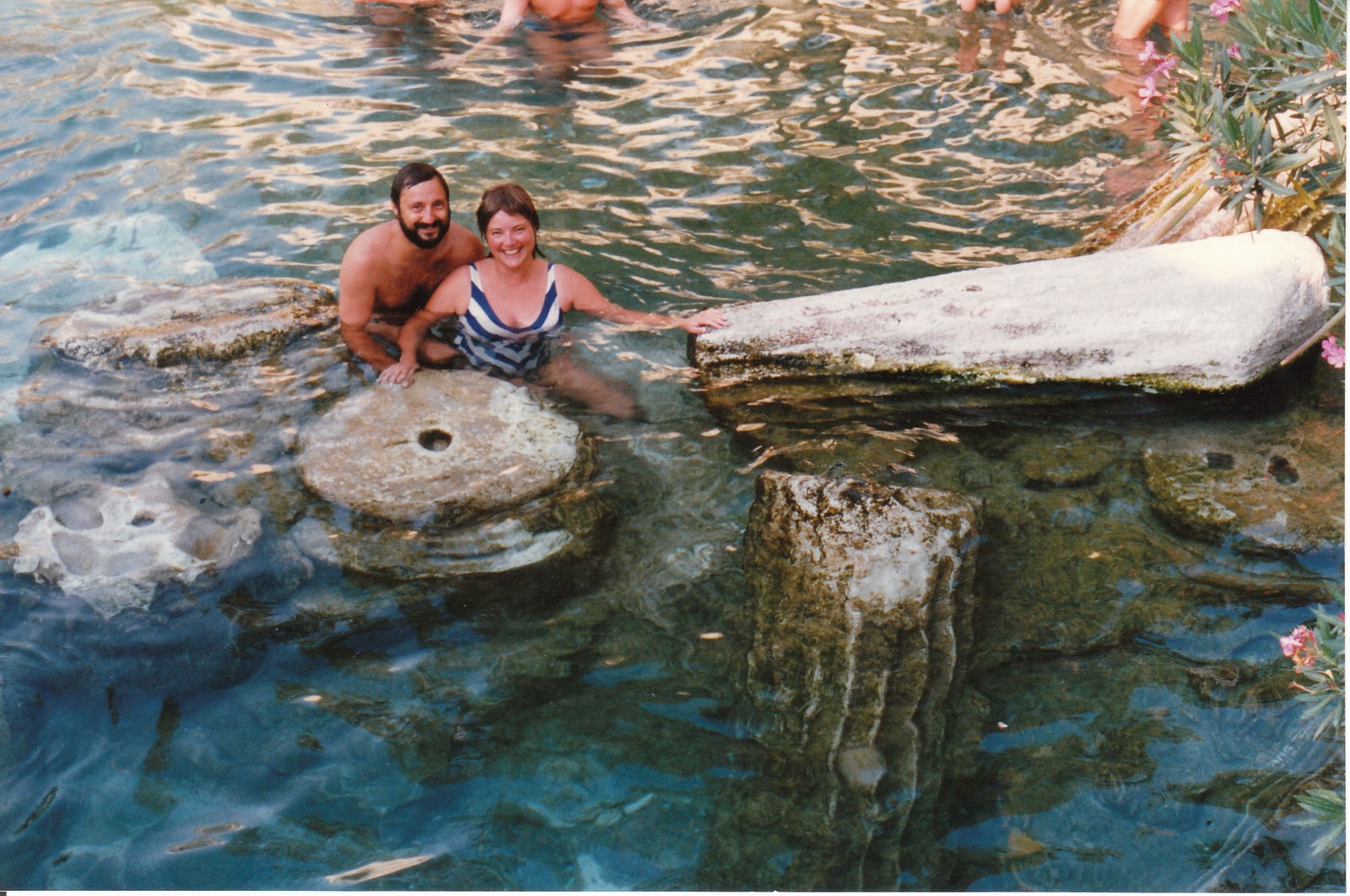
PAMUKKALE - Swimming in the ancient SACRED POOL
7 August 1989

In the grounds of what was the Pamukkale Motel (now a thermal centre) is the ancient Sacred Pool, warmed by hot springs and littered with underwater fragments of ancient marble columns. It is possibly associated with the Temple of Apollo. It was amazing swimmign around over anceinet ruins! During the Roman period, columned porticoes surrounded the pool; earthquakes toppled them into the water where they now lie.

This is where the spring that feeds the mineral pools of Pamukkale originates.


Saturday, 26 March 2011

Swimming - Paul Valéry


"To plunge into water, to move one's whole body in its wild and graceful beauty, to twist about in its pure depths, this is for me a delight only comparable to love." - Paul Valéry

Valéry (30 October 1871 – 20 July 1945) was a French poet, essayist, and philosopher.

Thursday, 24 March 2011

Swimming from Ancient Rome to Christianity

Sculpture of a mermaid found at a Roman fort near Fors Abbey at Bainbridge in Yorkshire, England.

One of my favourite books about swimming is Haunts of the Black Masseur : the Swimmer as Hero, by Charles Sprawson. I love his chapter on 'Classical Waters' (in Ancient Greece and Rome).

Sprawson tells us that in ancient Rome swimming was associated with sensuality and, eventually, as Emperors built ever more luxurious pools and baths, decadence. The Christian church filled the sea with imaginary monsters.

For Pliny the mermaid was a exciting proof of nature's diversity, her song an irresistible celestial harmony.

For the medieval church her siren song became the lure of fleshly pleasures to be feared and avoided by the godly. Swimming, like sexual pleasure, came to be associated with the devil and was almost suppressed during the domination of Europe by Christianity. Not until the beginning of the 19th century was its popularity revived.

Monday, 28 February 2011

Great Barrier Reef Low Isles


A fabulously beautiful place to swim and snorkel, which we did in October 2008. Luvin' the stinger suit (not!!)

Saturday, 26 February 2011

Noosa Main Beach


Noosa Main Beach is a lovely haven, a little more protected than some of the more open and "wild" surf beaches of the Sunshine Coast.  This is the last of the photos from our January 2011 Queensland holiday.

Friday, 25 February 2011

Caloundra Pool


This beachfront tidal saltwater pool is at Kings Beach, Caloundra. The day I visited the water was murky from recent discharge of floodwaters which had affected many Queensland beaches after the floods of January 2011.