Sunday, 16 October 2016

Darelle and Sally's Swimming Adventures - Clovelly Beach 16 October, 2016


Ready to snorkel

Until 1913 Clovelly was known as Little Coogee. It was named for a local estate of that name, which was named for the village of Clovelly on the north Devon coast. 

A tram line was completed to the suburb by 1913. What a pity it no longer exists, as traffic is very heavy. The line closed in 1957.

The concrete foreshores were constructed during the Great Depression as part of a work scheme. 

Clare Dennis (1916-1971) was a breaststroke gold medallist at the 1932 Olympics. She grew up in Clovelly and learned to swim in this bay. There should be a pool named after her, as there are for other Australian Olympic gold medallists (eg Ian Thorpe, Andrew Boy Charlton, Bev Whitfield, Dawn Fraser, Murray Rose, Michael Wenden, Fanny Durack)
Approaching from the north, looking over the long narrow inlet of Clovelly towards Coogee and the headland at Maroubra

Clovelly Bay

The surf rescue boat at the entrance to the bay is a good marker to swim around when doing laps 

The first surf life saving club was formed in 1907. 

Looking back towards the beach

The concreted edges and apron of the bay are the closest we have to a European style lido

Seaweeds underwater


Dog waiting eagerly for its human/s to return. No dogs allowed below


The yummy mummies have arrived

And a pool

The beach

Nearby, the bowling greens with the best view in Sydney. Looking north towards Bondi

And the cemetery with the best location in Sydney
Clovelly Bay before concreting

Clare Dennis in the lead at Los Angeles Olympics 1932

Clovelly swimmer Clare Dennis (middle in swimsuit) with team-mates Bonnie Mealing to her left and Frances Bult to right, Chaperone, and sprinters Eileen Wearne (Aus) and Thelma Kench (NZ) at 1932 Olympics. 


Monday, 3 October 2016

Darelle and Sally's Swimming Adventures: Congwong Beach, La Perouse 3 October 2016

It was cold. But true to our Adventure Creed, we did get in up to our waists! To count as an "adventure, we have to immerse ourselves.

This is Congwong Beach at La Perouse. A lovely sandy stretch, still water, no swimming enclosure.
It looks across the Heads of Botany Bay towards Kurnell. The small island is called Bare Island.

The beach has no facilities actually at the beach, but there are public toilets in the car parking area a couple of hundred metres away. The shops at La Perouse has several cafes and restaurants.

La Perouse is part of the traditional land of the Gweagal and Kameygal peoples of the Eora nation.
Its current name is after French navigator Jean-François de Galaup, comte de Lapérouse, who landed with two ships, the Astolabe and Boussole, on the northern shore of Botany Bay on 26 January 1788. Captain Arthur Phillip of Britain and the first fleet of convicts had arrived in Botany Bay a few days earlier.  The First Fleet was moving around to Port Jackson (Sydney Harbour) on that day, having found Botany Bay unsuitable for a settlement due to a lack of fresh water. Lapérouse was received amicably by the British, and offered any assistance he might need.

Relations were cordial, the French were not under orders to claim Terra Australia for France. Lapérouse sent his journals back to Europe with the British ship Sirius.

The expedition's naturalist and chaplain, Louis Receveur,  died at Botany Bay due to injuries received in a skirmish in Samoa, and was buried at Frenchman's Cove below the headland. He was the second European to be buried in Australia (the first was Forby Sutherland from Cook's 1770 expedition).

The French stayed for 6 weeks, built a stockade, observatory and garden on the Laperouse peninsula, before sailing for New Caledonia, Santa Cruz, the Solomons and the Louisiades. Lapérouse wrote that he expected to be back by December 1788,but the two ships vanished. The expedition was wrecked on a reef in the Solomon Islands, during a cyclone in April or May 1788. The shipwrecks were discovered in 1964.

Bare Island was described in 1770 by Captain Cook, who anchored on the opposite shore, as a "small bare island." In 1877 a fort was built on the island to reduce the odds of an attack on Sydney by what was considered its back door. Work was begun in 1889. In 1890 a Royal Commission found that construction was faulty due to the use of inferior concrete, and it started to crumble before it was completed. It was soon redundant, and decommissioned in 1902. in 1912 it became a retirement home for war veterans from the Crimea, Sudan and China campaigns. It became an historical site in 1963.

Tom Cruise rode around it on a motorbike in a chase sequence in Mission Impossible II.

At first we thought the water would be ok, as this woman was swimming slowly back and forth. Turns out she was made of hardier stuff than us! 


Darelle went first


We managed to make it to the tops of our legs; then they went numb.


The footbridge to Bare Island

The Heads of Botany Bay


Hold on to your hats, girls! 


Monday, 25 July 2016

Franklin and Eleanor Roosevelt and swimming: Val Kill

Franklin R partook in swimming therapy to help ameliorate the effects of his polio. He used to spend time at the Merriman Inn in Warm Springs in Georgia, where he swam in the natural spring water. In 1926 he bought the property and founded a therapy centre, which still exists. FDR died at Warm Springs. 

Meanwhile, at her property at Hyde Park, New York, Eleanor built a pool. It was a favourite family gathering place. There is home 16mm film footage recording the Roosevelts and friends and guests swimming there. One of the guests was Winston Churchill. 
In the filmed fictionalised account of the royal visit of King George VI and Queen Elizabeth (Hyde Park on Hudson) KGVI (Samuel West) is depicted swimming there with FDR (Bill Murray).


A project is underway to restore the pool. When we visited it was covered by boards (see photos below)


Eleanor Roosevelt at the Val-Kill pool.

Val-Kill pool, Summer 1940. FDR, Missy Le Hand and Eleanor R. From https://fdrlibrary.wordpress.com/tag/val-kill/
Eleanor on the lawn by the Val-Kill pool, Summer 1959. Photo by Keith M. Taylor. From https://fdrlibrary.wordpress.com/tag/val-kill/

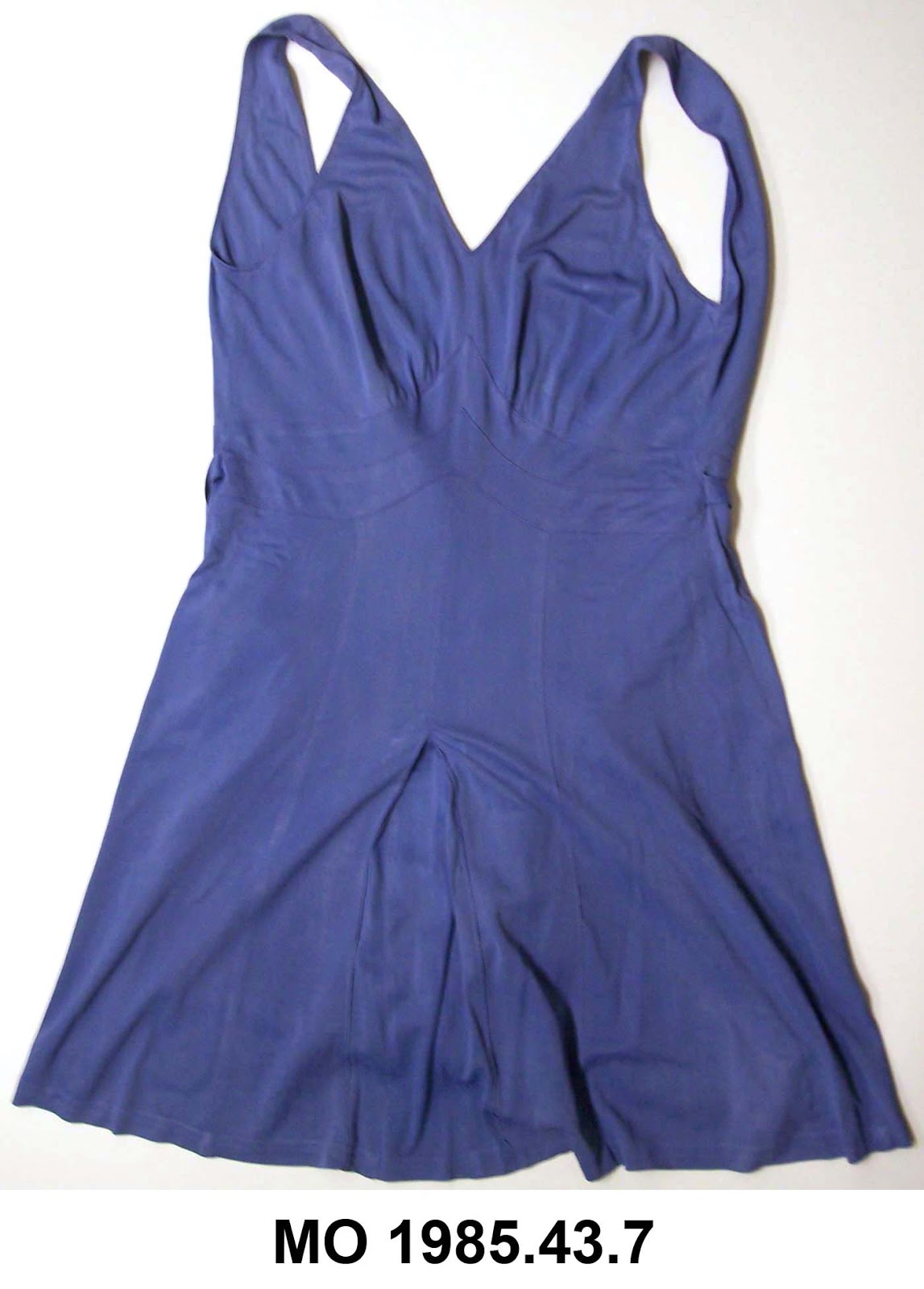
Eleanor's swimsuit. From https://fdrlibrary.wordpress.com/tag/val-kill/


How the pool looked on Sep 15, 2013 when we visited.


David Hockney: A diver (1978). National Gallery of Australia


I love and adore the National Gallery of Australia (NGA) in Canberra. Its Aboriginal art is unsurpassed. But its modern international collection is also stunning. There are examples of the best of the best. One of my favourites is this one by David Hockney - A diver.

The NGA's website says this about this work:

"In the late 1970s Hockney was intrigued by the expressive qualities of paper pulp which prompted him to embrace colour and scale. Taking the swimming pool as his subject, he explored the ripples of reflection on the steps, the diving board, and the effect of light and shadow on the water at different times of day by painting with liquid paper pulp. The pinnacle of the series is A diver, which depicts the splash of water created by the body as it enters the pool."
It is made from twelve abutted sheets of handcrafted sheets of hand-coloured pressed paper pulp.

(To the left of this painting is another Hockney - A Bigger Grand Canyon. Nearby is Lucien Freud's After Cezanne and Andy Warhol's undisputed masterpiece, Blue Poles. There's works by William de Kooning, Francis bacon, one of the world's largest collections of Roy Lichtenstein's works, Andy Warhol, Mark Rothko, Henri Matisse, Claude Monet....and of course, great Australian, Pacific and Asian art.

Monday, 11 July 2016

Film: The Together Project

This film caught my eye in the program for the Scandinavian film festival, so I went along tonight with a couple of friends. We spent a really enjoyable 80+ minutes chuckling along. After seeing Rams, also from Iceland, earlier this year, I've come to appreciate that Icelandic humour is....well, different...I can't possibly describe it, but deadpan and a bit off-the-wall might be apt.

A French / Icelandic co-production, it was certainly a quirky romcom, based around a swimming pool, a congress of lifeguards, and swimming in an Icelandic hotpool.

Here's some reviews:

The Hollywood Reporter.
Screen Daily

An excerpt on You Tube:


Tuesday, 28 June 2016

The Pool: Australia's exhibition at the 2016 Venice Architecture Biennale

Australia's exhibition at the 2016 Venice Architecture Biennale is The Pool. It provides an insight into this aspect of Australia's cultural identity. Janet Holmes a Court, the Commissioner for the Australian exhibition writes: "A pool has been created within the exhibition space along with an immensely multi-sensory experience that transports visitors poolside..."

As I can't visit Venice this year, I've contented myself with buying the book. There are contributions from:

  • Tim Flannery - an influential environmentalist, discussing the history and continuing relevance of the Great Artesian Basin, including the hot pools at Moree, Lightning Ridge and Pilliga in NSW and other states;
  • Ian Thorpe, Olympic champion, talks about what is so appealing about the act of swimming, what he loves about pools and the feel of water;
  • Designers Anna Plunkett and Luke Sales explore their experiences of the pool growing up, and the pool in memories of childhood;
  • Christos Tsolkas, author of Barracuda (starting soon as a drama series on ABC TV). He sees the pool as a deeply symbolic artefact of Australian culture. He tells the story of the pool from his childhood into adulthood;
  • Anna Funder, award winning author, looks at the importance of public pools in the towns and cities of Australia;
  • Hetti Perkins tells the story of the Freedom Riders who challenged the exclusion of Aboriginal people from the public pool in Moree in 1965. It was a turning point for the struggle for Aboriginal rights in Australia; working towards a PhD on the role of the public pool in Australia. Here she talks about competitive swimming and its legacy;
  • Singer-songwriter Paul Kelly has got into deep water in many places on his tours and speaks of a place for family gatherings, celebrations and everyday meditations. 
It even includes my favourite Women's Weekly swimming pool cake recipe. And lots of great illustrations.


Friday, 11 March 2016

Darelle and Sally's Swimming Adventures Part 7: South Coogee and South Maroubra

On a fairly overcast, but hot and humid day, we set off to find the rock pool (Ivor Rowe) at South Coogee. It's a natural pool which was enlarged in the 1960s.

We arrived at high tide, and there was a high swell, so we didn't venture down - the steps looked really really slippery too - lots of algae on them.


So, we took off to search for the rock pools at South Maroubra, to discover that they are mainly revealed at low tide. We arrived at peak high tide (1.83m). Still, there were pools and headland to explore, and a nice cup of coffee back at the cafe at the Surf Club afterwards!


Fortunately we only saw the sign!