At the Rockdale Council meeting on Wed 7 Dec, a unanimous decision was made to go ahead with the next phase of the pool re-development: commuity engagement. Consultation feedback is called for, starting Dec 13 and running to early March 2012.
As Mark Hanna, spokesperson for the pool supporters' said:
"After three solid years of intense lobbying, petitions and meeting attendance, we finally have something concrete to comment on. I cannot stress enough how important it is to flood council with favourable feedback on the proposed concept plans and facility mix."
All the information is available at the Rockdale Council website:
http://www.rockdale.nsw.gov.au/Council_Projects/Pages/Projects_BexleySwimming.aspx
Alternatively, they have set up a special email address for feedback as well. The email address is bexpool@rockdale.nsw.gov.au
The St George and Sutherland Shire Leader carries a front page story on the proposed upgrade. People can also go onto their site and make comments. Here is the link: http://www.theleader.com.au/news/local/news/general/new-life-for-bexley-pool/2390133.aspx
This is our chance to get this project over the line and secure the long term future of Bexley Pool. Please help by providing positive feedback. Without this upgrade, the future of Bexley Pool remains highly uncertain.
Pictures are courtesy of architects TompkinsMDA. Look at the link to see their other aquatic centre designs.
Thursday, 15 December 2011
Friday, 2 December 2011
Bexley pool: proposal for re-development
Those of you who follow this blog regularly will know about my love affair with my local pool, Bexley Swimming Centre. You can catch up with previous blogs about Bexley by clicking that link.
There's been a community drive led by regular pool users to have the local Council attend to serious concerns about the viability of the centre. The fact that it is one of Sydney's "best kept secrets" - an under-utilised facility in a beautiful almost bushland setting which is a year-round suntrap is not enough to ensure that it remains as a public amenity into the future.
The tenacity of the leaders of the campaign is most admirable. It has taken many rounds of lobbying, addressing Council meetings and attendance at reference group meetings to reach a situation where a concrete propsal to emerge.
What has been presented is magnificent, as the illustrations show.
Pictures are courtesy of architects TompkinsMDA. Look at the link to see their other aquatic centre designs.
The report says that at the moment there are 130 000 visits a year, each of which is "subsidised" at $3.02 (I have a little trouble with this concept - a public amenity is what people pay rates for....but I digress....). It is estimated that the re-developed facility would atttract 541 000 annual visits, at a subsidy of $0.79 per visit.
The design concept has: a new outdoor 50m pool with seating and shade and an indoor facility containing an 8 lane 25m pool, a learn to swim and warm water exercise pool, a children's play pool, a spa and sauna and 700sq m of dry fitness space with a gym and group exercise rooms. It would also have a creche, children's party room, kiosk and amenities.
A quantity surveyor has estimated the cost at $26.81 million.
Several recommendations which progress the concept will go to Council next Wednesday. Read the full report here. Below are drawings accompanying the report.
![]() |
| Current layout |
![]() |
| Proposed overview |
![]() |
| More detail of proposed indoor facility |
![]() |
| Indoor and outdoor pools |
Thursday, 1 December 2011
Sydney's Ocean Baths & Other Musings - Ian Swift
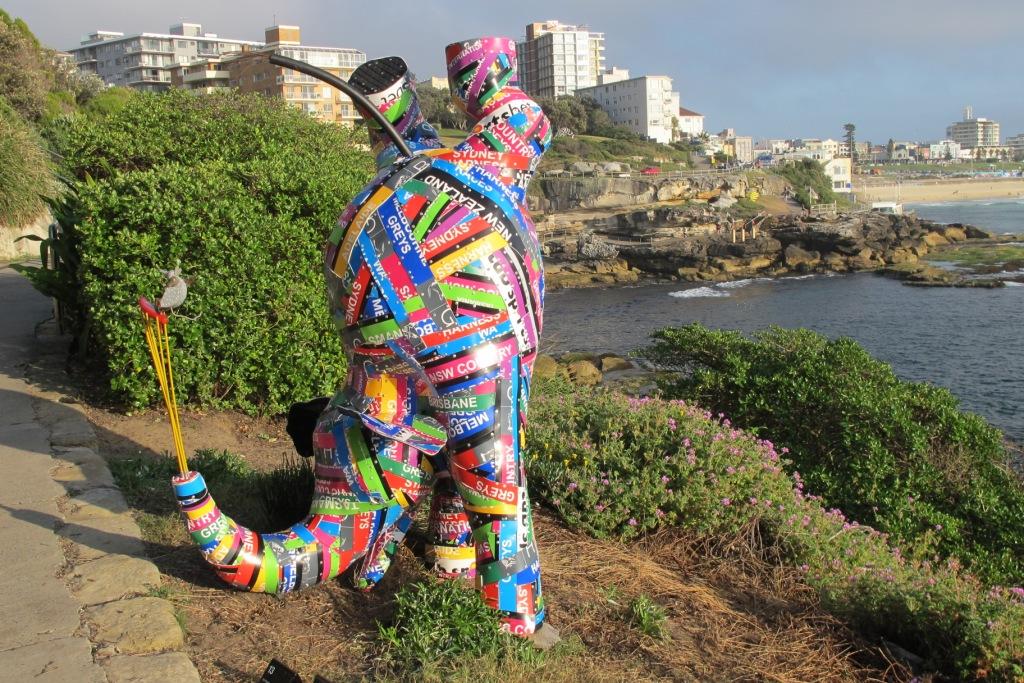
The colourful elephant sculpture is called Extreme Surfing. It is by Katoomba artist, Ian Swift, and was on display in this year's Sculpture By The Sea exhibition, which takes place annually along the walk between Bondi and Tamarama beaches in Sydney.
I had a look for more of Swift's work, and came across the catalogue for an exhibition held in 2005 called Sydney's Ocean Baths (above). I am captivated by these works, and ordered a catalogue.
Below are his representations of two of my favourite Sydney ocean pools: McIver's Women's Pool at Coogee, and Mahon Pool at Maroubra.
You can browse more of his works here.
Below are his representations of two of my favourite Sydney ocean pools: McIver's Women's Pool at Coogee, and Mahon Pool at Maroubra.
You can browse more of his works here.
![]() |
| Mahon Pool, Maroubra |
![]() |
| McIvers (Women's pool), Coogee |
Monday, 30 May 2011
Public swimming pools NSW Central West and South
Swimming has been part of the Australian consciousness for a long time. In the late 19th century swimming baths were built in capital cities (see Melbourne City Baths, for example). Rock pools were built along the Sydney coast as job creation schemes during the Great Depression. Modern aquatic centres are built as major competition venues.
And after the Melbourne Olympics in 1956, a golden age of community building resulted in almost every town council and its citizens striving for a community pool, and 50m Olympic pools spread across the suburbs of major cities (I blog regularly about Bexley pool for example, opened in the 1970s).
My mate John travels for work around the towns of the NSW Central West and Riverina, and is partial to a swim. Here's a collection of snaps he's taken of various swimming venues.
![]() |
| Albury Swim Centre, February 2011 |
![]() |
| Canowindra February 2011 "At midday I was the first swimmer for the day" |
![]() |
| Cowra. "28 degree water temp is no good for me. Nice complex though. Toddlers pool is under cover." |
![]() |
| Gulgong. May 2011 |
![]() |
| Tumbarumba February 2011 "Very clear, delightfully cool water." |
![]() |
| Tumut March 2011 |
![]() |
| Tumut March 2011 |
![]() |
| Wodonga. Feb 2011. This has been closed down - outrageous! |
![]() |
| Young February 2011 |
Sunday, 29 May 2011
Swimming travellers
I love it when I read about someone else who seeks out swimming spots when travelling.
This piece was in the travel section of the Sydney Morning Herald yesterday.
See my pictures of the pool mentioned - click here.
See my pictures of Barceloneta and the beach - click here.
Tower and arch ... the sculpture Homentage a la Barceloneta, by Rebecca Horn, on the foreshore. Photo: Getty Images
The best of Barcelona is revealed when Liz Porter indulges her passion for swimming and architecture.
Late on a Friday afternoon, I'm swimming slowly beside Barceloneta, the main beach of Barcelona, looking back at cafes filling with locals making a start on their weekend. But my eyes are drawn to the golden shimmering scales of a giant fish, just above the shoreline, a few hundred metres further along the beach. This 35-metre by 54-metre fantasy in steel lattice and copper is the work of the celebrated American architect Frank Gehry, creator of Bilbao's famous Guggenheim. One of a clutch of artworks and buildings commissioned from foreign architects and artists in preparation for the 1992 Olympic Games, it stands in front of the Port Olimpic skyscraper, Hotel Arts, designed as the flagship hotel for the Games - and now famous for its luxurious 43rd-floor spa.
I'm not just swimming. Rather, I'm doing the aquatic version of a sightseeing promenade. A "swimenade"? It works well, even if it means doing the ungainly head-out-of-water breaststroke favoured by women who want to swim without getting their hair wet.
Mies van der Rohe's showpiece pavilion. Photo: AFP
But what kind of lunatic, some might wonder, would visit Barcelona - city of magnificent contemporary art galleries, phantasmagorical Gaudi architecture, uber-cool bars in mediaeval alleyways - and then go to the beach?
Finding a place to swim, no matter where I go, is my personal eccentricity but I recommend it to anyone. Breaking a culture-rich city holiday with a dip is a guaranteed delight, even for tourists who are neither lap counters nor ocean racers at home. Swimming soothes feet that are tired from shuffling through churches and it calms brains that are overloaded with snippets of cultural information from gallery walls and audio guides- or overheard when eavesdropping at the back of tour groups with their own gallery guide.
Swimming offers the privilege of mixing with a city's inhabitants on equal terms. It's also an opportunity to examine the cultural differences expressed in national swimming habits. In German pools, for example, swimming without a bathing cap is "strengst verboten". Berlin's pool culture permits people to swim two abreast, paddling a slow breaststroke while talking - a lack of respect for the concept of "lanes" that is, well, un-Australian.
One day, we take the funicular railway, part of the city's metro system, to Montjuic, a flat-topped hill that is the site of an Olympic stadium and of a clutch of extraordinary galleries. These include the grand Museu Nacional d'Art de Catalunya, or National Art Museum of Catalonia (known as MNAC) and architect Mies van der Rohe's pavilion, an achingly elegant symphony of light, air, marble and glass that he built as Germany's showpiece for the 1929 World Exhibition.
Dismantled afterwards, it was rebuilt in 1986 and is a compulsory stop on every architect's European pilgrimage (Avenue Francesc Ferrer i Guardia 7; miesbcn.com/en/pavilion.html).
There's also the Fundacio Joan Miro, housing the huge collection of work given by the artist to his home town. Today, its temporary exhibition is Dawn Chorus, a video installation by eccentric English artist Marcus Coates, for which he has recorded birdsong, slowed it down so professional singers could learn the component notes, filmed them singing it and then sped up the film again, with hilarious and intriguing results.
Afterwards, the lush greenery of Montjuic's gardens is a tonic for gallery-tired eyes - perhaps the tulips and water lilies of the Jardins de Mossen Cinto de Verdaguer, specialising in bulbs and water plants, or the collection of plants from around the world at the Jardi Botanic.
Predictably, I opt to swim. The city's diving pool is closed; with its panoramic views of the city, it was admired by a global television audience in 1992 and featured in the video for Kylie Minogue's 2003 hit Slow. So we walk instead to Montjuic's Piscines Bernat Picornell, built in 1970, renovated for the Olympics and featuring interesting cultural differences: a Saturday-night session, topless sunbathing beside the outdoor pool and horizontally strung lanes in the indoor Olympic pool (Avinguda Estadi, 30-38).
On our itinerary is the 18th-century convent that houses Museu Picasso, with its collection of the early representational work created before the artist became a cubist (Carrer Montcada 15-23; www.museupicasso.bcn.cat/en). I'm thrilled to find Picasso's Barceloneta Beach, painted in 1896, showing my new favourite beach with donkeys on the sand, fishermen's cottages where the cafes now stand and smoking chimney stacks of factories of the neighbouring suburb of Poblenou in the background. At five in the afternoon, I'm back there for a late dip.
We're renting a renovated, shuttered studio apartment in a picturesquely narrow street in the Gothic El Born area, one of the city's oldest neighbourhoods. The 14th-century Santa Maria del Mar cathedral is less than 100 metres away and we're eating the best tapas we've ever had at Bubo, on the edge of its square (Caputxes 10; bubo.ws). We later discover that The New York Times was talking up Bubo's grilled eggplant and fetta - and its exquisite jewel-like cakes - in 2007. But so what? We stumble across it on our first night, after a week in Britain with its chain-run eateries, and we're thrilled.
It's a residential area so we can buy good bread and the finest jamon iberico at shops around the corner. We can stroll to the markets of La Boqueria on La Rambla and the Santa Caterina market, with its wavy multicoloured roof and chic tapas bar. But, best of all, Barceloneta is only 10 minutes' walk from our apartment.
Many snooty bloggers deride this beach and all the others in the immediate area, from Port Olimpic to Bogatell and Mar Bella, insisting that the closest beach worth visiting is at Sitges, a charming resort 40 kilometres south-west of Barcelona, with whitewashed houses, steep winding alleys and a baroque church overlooking the water. We dutifully take the 45-minute train trip to Sitges, arriving on the last day of its annual October film festival (and we discover that film-festival queues look the same as they do in Australia). In fact, the Australian thriller-western Red Hill is screening when we arrive but we choose to stroll along the waterfront instead - and, of course, to swim.
So I remain faithful to Barceloneta. It's a city beach, to be judged by city-beach standards. The clarity of its 21-degree water in late summer is no worse than Melbourne's Brighton beach or Sydney's Redleaf. Better than that, Barceloneta is a beach with a story: a key chapter in the dramatic transformation of the city for the 1992 Olympics.
Another giant beachside sculpture draws me into this narrative. Homenatge a la Barceloneta is a leaning tower of steel boxes with glass windows erected on the sand at Barceloneta, just a stone's throw from a seafood restaurant called Can Majo, which we later visit after reading a foodie website's recommendation that it has the best paella in the city (Almiral Aixada 23; canmajo.es).
The work of the German sculptor Rebecca Horn, Homenatge is a tribute to the ramshackle beach bars and cafes swept away when the beach area was redeveloped for the Games. The choice of subject matter might suggest a critical attitude by the artist but Barcelona residents appear to have been thrilled by an urban transformation that turned the city's face to the water and gave them somewhere to sail, windsurf and swim.
Before the Games, Barcelona had sea but no "beach" in the sense that other Mediterranean cities understand it. Before 1992, Barceloneta was regarded as edgy and slightly dangerous. Gypsies camped on the beach at night and locals came only for the boxy little beach bars set up on the sand. A railway line ran close by, cutting off the adjacent area of Poblenou, then full of disused factories and derelict housing, from the rest of the city. It also cut the city off from the beach.
The Olympic Games makeover, masterminded by socialist mayor Pasqual Maragall, brought marinas, new housing, luxury restaurants with suede couches on their beachside terraces and a bayside promenade, ideal for cycling and new housing. Sand was trucked in to build up a planned three kilometres of beach, which increased to five. The railway line was torn up and the tracks moved underground.
Now, the southern end of Poblenou, once the site of the Olympic village, is the residential area of Port Olimpic. Like the rest of the city, it's dotted with the work of the world's most fashionable architects, including French architect Jean Nouvel's 38-storey Torre Agbar, headquarters of the local water supply company and nicknamed the "Gherkin".
Like most visitors, we spend hours absorbing the whimsy of Barcelona's genius son, Antoni Gaudi, visiting his technicoloured Park Guell and touring his Casa Batllo and La Pedrera apartment blocks. But we are also captivated by the work of his fellow modernista (or Catalan art nouveau) architects such as Josep Puig i Cadalfalch, creator of such urban Gothic fantasies as the Casa de les Punxes (1903-5), a turreted castle that occupies a whole block and now houses offices; and Lluis Domenech i Montaner.
There are daily tours of Montaner's Palau de la Music Catalana, with its fevered interior of flying horses and sculpted roses (Carrer del Palau de la Musica 4, El Born; www.palaumusica.org). But we take it in at leisure, listening to a Bulgarian symphony orchestra concert here. We walk past the gorgeous Gran Teatre del Liceu, destroyed by fire in 1994 and rebuilt in 1999 to the 1861 plans, with the addition of such new technology as an electronic libretto system offering most seats a choice of English, Spanish and Catalan surtitles on small screens. Bizet's Carmen is playing and for an eye-watering €184 ($244) each we buy seats - in a burgundy velvet-lined box - for enfant terrible director Calixto Bieito's radical staging of the opera, with 1980s costumes and male nude scene.
We also visit i Montaner's Casa Fuster, the luxury hotel featured in Woody Allen's Vicky Cristina Barcelona, and have a drink in a foyer bar that preserves the original 1908 decor (Passeig de Gracia 132).
Like most tourists, we're besotted by the city's historic buildings. But the locals are more inclined to line up to see modern architect-designed interiors.
On Sunday afternoon, as we dawdle along Passeig de Gracia, on our way to Gaudi's Casa Batllo, we spot what looks like a queue of film-festival types outside the Mandarin Hotel. It's an open day to inspect the interior, the work of Spanish designer Patricia Urquiola. Later the same day, we pass a similar queue of interior-architecture fans outside Casa Camper, a boutique hotel near the university and designed by the company behind the well-known shoes.
I decide to do what the Barcelonans do. I take a personal tour of the 42nd and 43rd floor of the Hotel Arts, visiting the Six Senses spa for a massage and a dip in its warm plunge pool-with-a-view (Marina 19-21; hotelartsbarcelona.com). Afterwards I sit in my pristine white hotel dressing gown, sipping a cup of ginger tea, served with one shiny date and one dried fig, and stare down at sailboats skimming across the glittering blue of the Mediterranean. Far below me a solitary swimmer paddles along the shoreline. Someone else on a "swimenade", perhaps.
Singapore Airlines has a fare to Barcelona for about $1980 low-season return from Melbourne and Sydney including tax. You fly to Singapore (8hr), then Barcelona (13hr 35min there and 12hr 50min return).
Read more: http://www.smh.com.au/travel/holiday-type/beach/best-of-barcelona-master-strokes-20110527-1f7zx.html#ixzz1NhZpudyt
This piece was in the travel section of the Sydney Morning Herald yesterday.
See my pictures of the pool mentioned - click here.
See my pictures of Barceloneta and the beach - click here.
Best of Barcelona: master strokes
May 28, 2011
Late on a Friday afternoon, I'm swimming slowly beside Barceloneta, the main beach of Barcelona, looking back at cafes filling with locals making a start on their weekend. But my eyes are drawn to the golden shimmering scales of a giant fish, just above the shoreline, a few hundred metres further along the beach. This 35-metre by 54-metre fantasy in steel lattice and copper is the work of the celebrated American architect Frank Gehry, creator of Bilbao's famous Guggenheim. One of a clutch of artworks and buildings commissioned from foreign architects and artists in preparation for the 1992 Olympic Games, it stands in front of the Port Olimpic skyscraper, Hotel Arts, designed as the flagship hotel for the Games - and now famous for its luxurious 43rd-floor spa.
I'm not just swimming. Rather, I'm doing the aquatic version of a sightseeing promenade. A "swimenade"? It works well, even if it means doing the ungainly head-out-of-water breaststroke favoured by women who want to swim without getting their hair wet.
Finding a place to swim, no matter where I go, is my personal eccentricity but I recommend it to anyone. Breaking a culture-rich city holiday with a dip is a guaranteed delight, even for tourists who are neither lap counters nor ocean racers at home. Swimming soothes feet that are tired from shuffling through churches and it calms brains that are overloaded with snippets of cultural information from gallery walls and audio guides- or overheard when eavesdropping at the back of tour groups with their own gallery guide.
Swimming offers the privilege of mixing with a city's inhabitants on equal terms. It's also an opportunity to examine the cultural differences expressed in national swimming habits. In German pools, for example, swimming without a bathing cap is "strengst verboten". Berlin's pool culture permits people to swim two abreast, paddling a slow breaststroke while talking - a lack of respect for the concept of "lanes" that is, well, un-Australian.
One day, we take the funicular railway, part of the city's metro system, to Montjuic, a flat-topped hill that is the site of an Olympic stadium and of a clutch of extraordinary galleries. These include the grand Museu Nacional d'Art de Catalunya, or National Art Museum of Catalonia (known as MNAC) and architect Mies van der Rohe's pavilion, an achingly elegant symphony of light, air, marble and glass that he built as Germany's showpiece for the 1929 World Exhibition.
Dismantled afterwards, it was rebuilt in 1986 and is a compulsory stop on every architect's European pilgrimage (Avenue Francesc Ferrer i Guardia 7; miesbcn.com/en/pavilion.html).
There's also the Fundacio Joan Miro, housing the huge collection of work given by the artist to his home town. Today, its temporary exhibition is Dawn Chorus, a video installation by eccentric English artist Marcus Coates, for which he has recorded birdsong, slowed it down so professional singers could learn the component notes, filmed them singing it and then sped up the film again, with hilarious and intriguing results.
Afterwards, the lush greenery of Montjuic's gardens is a tonic for gallery-tired eyes - perhaps the tulips and water lilies of the Jardins de Mossen Cinto de Verdaguer, specialising in bulbs and water plants, or the collection of plants from around the world at the Jardi Botanic.
Predictably, I opt to swim. The city's diving pool is closed; with its panoramic views of the city, it was admired by a global television audience in 1992 and featured in the video for Kylie Minogue's 2003 hit Slow. So we walk instead to Montjuic's Piscines Bernat Picornell, built in 1970, renovated for the Olympics and featuring interesting cultural differences: a Saturday-night session, topless sunbathing beside the outdoor pool and horizontally strung lanes in the indoor Olympic pool (Avinguda Estadi, 30-38).
On our itinerary is the 18th-century convent that houses Museu Picasso, with its collection of the early representational work created before the artist became a cubist (Carrer Montcada 15-23; www.museupicasso.bcn.cat/en). I'm thrilled to find Picasso's Barceloneta Beach, painted in 1896, showing my new favourite beach with donkeys on the sand, fishermen's cottages where the cafes now stand and smoking chimney stacks of factories of the neighbouring suburb of Poblenou in the background. At five in the afternoon, I'm back there for a late dip.
We're renting a renovated, shuttered studio apartment in a picturesquely narrow street in the Gothic El Born area, one of the city's oldest neighbourhoods. The 14th-century Santa Maria del Mar cathedral is less than 100 metres away and we're eating the best tapas we've ever had at Bubo, on the edge of its square (Caputxes 10; bubo.ws). We later discover that The New York Times was talking up Bubo's grilled eggplant and fetta - and its exquisite jewel-like cakes - in 2007. But so what? We stumble across it on our first night, after a week in Britain with its chain-run eateries, and we're thrilled.
It's a residential area so we can buy good bread and the finest jamon iberico at shops around the corner. We can stroll to the markets of La Boqueria on La Rambla and the Santa Caterina market, with its wavy multicoloured roof and chic tapas bar. But, best of all, Barceloneta is only 10 minutes' walk from our apartment.
Many snooty bloggers deride this beach and all the others in the immediate area, from Port Olimpic to Bogatell and Mar Bella, insisting that the closest beach worth visiting is at Sitges, a charming resort 40 kilometres south-west of Barcelona, with whitewashed houses, steep winding alleys and a baroque church overlooking the water. We dutifully take the 45-minute train trip to Sitges, arriving on the last day of its annual October film festival (and we discover that film-festival queues look the same as they do in Australia). In fact, the Australian thriller-western Red Hill is screening when we arrive but we choose to stroll along the waterfront instead - and, of course, to swim.
So I remain faithful to Barceloneta. It's a city beach, to be judged by city-beach standards. The clarity of its 21-degree water in late summer is no worse than Melbourne's Brighton beach or Sydney's Redleaf. Better than that, Barceloneta is a beach with a story: a key chapter in the dramatic transformation of the city for the 1992 Olympics.
Another giant beachside sculpture draws me into this narrative. Homenatge a la Barceloneta is a leaning tower of steel boxes with glass windows erected on the sand at Barceloneta, just a stone's throw from a seafood restaurant called Can Majo, which we later visit after reading a foodie website's recommendation that it has the best paella in the city (Almiral Aixada 23; canmajo.es).
The work of the German sculptor Rebecca Horn, Homenatge is a tribute to the ramshackle beach bars and cafes swept away when the beach area was redeveloped for the Games. The choice of subject matter might suggest a critical attitude by the artist but Barcelona residents appear to have been thrilled by an urban transformation that turned the city's face to the water and gave them somewhere to sail, windsurf and swim.
Before the Games, Barcelona had sea but no "beach" in the sense that other Mediterranean cities understand it. Before 1992, Barceloneta was regarded as edgy and slightly dangerous. Gypsies camped on the beach at night and locals came only for the boxy little beach bars set up on the sand. A railway line ran close by, cutting off the adjacent area of Poblenou, then full of disused factories and derelict housing, from the rest of the city. It also cut the city off from the beach.
The Olympic Games makeover, masterminded by socialist mayor Pasqual Maragall, brought marinas, new housing, luxury restaurants with suede couches on their beachside terraces and a bayside promenade, ideal for cycling and new housing. Sand was trucked in to build up a planned three kilometres of beach, which increased to five. The railway line was torn up and the tracks moved underground.
Now, the southern end of Poblenou, once the site of the Olympic village, is the residential area of Port Olimpic. Like the rest of the city, it's dotted with the work of the world's most fashionable architects, including French architect Jean Nouvel's 38-storey Torre Agbar, headquarters of the local water supply company and nicknamed the "Gherkin".
Like most visitors, we spend hours absorbing the whimsy of Barcelona's genius son, Antoni Gaudi, visiting his technicoloured Park Guell and touring his Casa Batllo and La Pedrera apartment blocks. But we are also captivated by the work of his fellow modernista (or Catalan art nouveau) architects such as Josep Puig i Cadalfalch, creator of such urban Gothic fantasies as the Casa de les Punxes (1903-5), a turreted castle that occupies a whole block and now houses offices; and Lluis Domenech i Montaner.
There are daily tours of Montaner's Palau de la Music Catalana, with its fevered interior of flying horses and sculpted roses (Carrer del Palau de la Musica 4, El Born; www.palaumusica.org). But we take it in at leisure, listening to a Bulgarian symphony orchestra concert here. We walk past the gorgeous Gran Teatre del Liceu, destroyed by fire in 1994 and rebuilt in 1999 to the 1861 plans, with the addition of such new technology as an electronic libretto system offering most seats a choice of English, Spanish and Catalan surtitles on small screens. Bizet's Carmen is playing and for an eye-watering €184 ($244) each we buy seats - in a burgundy velvet-lined box - for enfant terrible director Calixto Bieito's radical staging of the opera, with 1980s costumes and male nude scene.
We also visit i Montaner's Casa Fuster, the luxury hotel featured in Woody Allen's Vicky Cristina Barcelona, and have a drink in a foyer bar that preserves the original 1908 decor (Passeig de Gracia 132).
Like most tourists, we're besotted by the city's historic buildings. But the locals are more inclined to line up to see modern architect-designed interiors.
On Sunday afternoon, as we dawdle along Passeig de Gracia, on our way to Gaudi's Casa Batllo, we spot what looks like a queue of film-festival types outside the Mandarin Hotel. It's an open day to inspect the interior, the work of Spanish designer Patricia Urquiola. Later the same day, we pass a similar queue of interior-architecture fans outside Casa Camper, a boutique hotel near the university and designed by the company behind the well-known shoes.
I decide to do what the Barcelonans do. I take a personal tour of the 42nd and 43rd floor of the Hotel Arts, visiting the Six Senses spa for a massage and a dip in its warm plunge pool-with-a-view (Marina 19-21; hotelartsbarcelona.com). Afterwards I sit in my pristine white hotel dressing gown, sipping a cup of ginger tea, served with one shiny date and one dried fig, and stare down at sailboats skimming across the glittering blue of the Mediterranean. Far below me a solitary swimmer paddles along the shoreline. Someone else on a "swimenade", perhaps.
Singapore Airlines has a fare to Barcelona for about $1980 low-season return from Melbourne and Sydney including tax. You fly to Singapore (8hr), then Barcelona (13hr 35min there and 12hr 50min return).
Read more: http://www.smh.com.au/travel/holiday-type/beach/best-of-barcelona-master-strokes-20110527-1f7zx.html#ixzz1NhZpudyt
Henry Scott Tuke
Born 12 June 1858 in York, died 13 March 1929 in Falmouth, Cornwall.
His family moved to Falmouth in Cornwall in 1859, where his father practiced medicine. (His father specialised in psychiatry and campaigned for the humane treatment of the insane. His family were social activists.
Harry spent long summer days swimming and on the beach. He engaged in nude sea bathing throughout his life.
Tuke drew and painted from an early age, and trained at the Slade school and in Italy and Paris. He settled in Cornwall.
More about Tuke in Wikipedia.
I first "met" Tuke in the opening passage of Charles Sprawson's book Haunts of the Black Masseur:
" I learnt to swim in India, in a pool donated to the school by the Edwardian cricketer Ranjitsinhji. I was the only English boy in the school. My father was the headmaster, and Sir K.S Ranjitsinghji, the Jam Saheb of Nawanagar, its most eminent old-boy, though he was only one prince among many there. Sometimes his successor allowed us to bathe in the flooded subterranean vaults of his palace nearby, among columns that disappeared mysteriously into black water. On the walls of the palace above there still hung Tuke's paintings of bathing boys that the Jam Saheb had collected during his cricketing years in England." (Sprawson p1-2)
His family moved to Falmouth in Cornwall in 1859, where his father practiced medicine. (His father specialised in psychiatry and campaigned for the humane treatment of the insane. His family were social activists.
Harry spent long summer days swimming and on the beach. He engaged in nude sea bathing throughout his life.
Tuke drew and painted from an early age, and trained at the Slade school and in Italy and Paris. He settled in Cornwall.
![]() |
| The Bathers 1888 |
![]() |
| Three Companions |
![]() |
| August Blue 1893 |
![]() |
| Boys Bathing 1907 |
![]() |
| Boys Bathing 1908 |
![]() |
| Boys Bathing 1912 |
![]() |
| Ruby Gold and Malachite 1902 |
![]() |
| The Bather 1924 |
More about Tuke in Wikipedia.
I first "met" Tuke in the opening passage of Charles Sprawson's book Haunts of the Black Masseur:
" I learnt to swim in India, in a pool donated to the school by the Edwardian cricketer Ranjitsinhji. I was the only English boy in the school. My father was the headmaster, and Sir K.S Ranjitsinghji, the Jam Saheb of Nawanagar, its most eminent old-boy, though he was only one prince among many there. Sometimes his successor allowed us to bathe in the flooded subterranean vaults of his palace nearby, among columns that disappeared mysteriously into black water. On the walls of the palace above there still hung Tuke's paintings of bathing boys that the Jam Saheb had collected during his cricketing years in England." (Sprawson p1-2)
Saturday, 28 May 2011
Famous swimmers: Edward II
Much maligned, and apparently seriously misrepresented in Mel Gibson's movie, Braveheart, Edward II was born at Caernarvon on 25 April 1284 and died, murdered (probably at the behest of his wife and her lover) at Berkeley Castle, Gloucestershire on 21 September 1327.
Edward was entirely unconventional. His long-term lover was a man, Piers Gaveston. His interests were un-kingly, ranging from rowing, estate management (including digging his own ditches), music and swimming.
He liked mixing it with common people, and according to a written source "spent a month swimming and rowing in theFens in 1315 ....with a great company of common people.” (Flores Historiarum, ed. H. R. Luard, vol. iii (1890), p. 165.)
Swimming was considered far less than appropriate for a King, and was not a common activity.
I wonder how he learned, and what motivated him?
I first read about Edward II's swimming proclivities in this book, Haunts of the Black Masseur: the swimmer as hero, by Charles Sprawson (1992). I'll do a review and separate blog entry on this book at some time
Edward was entirely unconventional. His long-term lover was a man, Piers Gaveston. His interests were un-kingly, ranging from rowing, estate management (including digging his own ditches), music and swimming.
He liked mixing it with common people, and according to a written source "spent a month swimming and rowing in the
Swimming was considered far less than appropriate for a King, and was not a common activity.
I wonder how he learned, and what motivated him?
I first read about Edward II's swimming proclivities in this book, Haunts of the Black Masseur: the swimmer as hero, by Charles Sprawson (1992). I'll do a review and separate blog entry on this book at some time
Cassis (June 2008)
Cassis is a gorgeous, relatively sleepy (though frenetic in high summer I believe) fishing town east of Marseille. We went there for a boat trip around Les Calanques, deeply incised cliffs. I loved the whole atmosphere of Cassis and would very much like to return for an extended period. Perhaps in retirement? With longer to linger, there are many walks in the area that would be worth doing. It seemed a perfect place to be on a deliciously warm late spring day, and the water wasn't TOO cold for a swim!
Above: Cap Canaille, the highest maritime cliffs on the Mediterranean.
Above: Swimming in the enclosure at Cassis Beach - that's Ben and Nathalie standing, and I'm "surfing" in to shore
Above: Post swim nap on the beach
Above: Racing off onto a pedalo
Above: The beach and facilities. The beach was REALLY hard to walk on because it is all fine pebbles that you sink into at every step
Above and Below: One the chief attractions of Cassis is the voat trips around "Les Calanques". This is Calanque En-Vau, perhaps the most beautiful of all. Other than getting a private boat there, and swimming off the boat, you can walk; it's about an hour from Cassis.


Subscribe to:
Posts (Atom)